

Ukrainian bond market
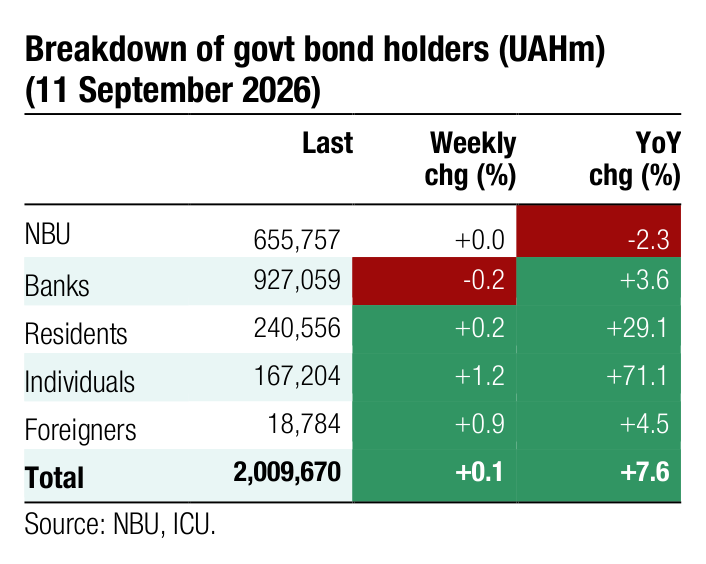
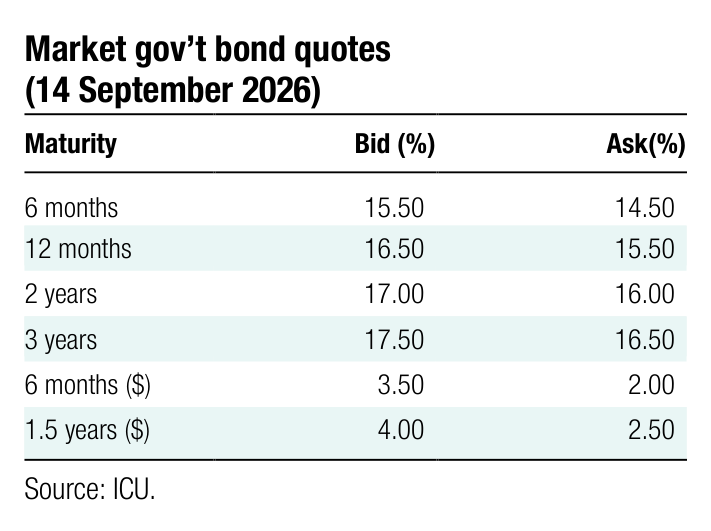
Yield on UAH bonds broadly unchanged
Since the NBU’s hike of key policy rate by 50bp in July, the Ministry of Finance has kept the primary-market yields on UAH bonds nearly unchanged, thereby preventing any meaningful moves in yields in the secondary market. Yields offered to retail investors have remained unchanged, as well.
After the National Bank raised the key policy rate by 50bp to 15.5% at the end of July, the MoF essentially disregarded the move and increased primary market yields by only a few basis points. Over the past 1.5 months, yields on one-year bonds rose by a mere 3bp, and yields on bonds maturing in 1.5 to 2 years increased by 11bp. Meanwhile, the yield on the longest-term instrument—maturing in February 2030—remained unchanged.
In the secondary bond market, yields on UAH bonds saw no significant changes during August and early September. For instance, the weighted average yields on executed trades for military bonds due in the spring and summer of 2027 remained in the 15ꟷ15.4% range throughout this period. Quoted yields for retail clients also remained unchanged at 15ꟷ17% for maturities in 2027-2030.
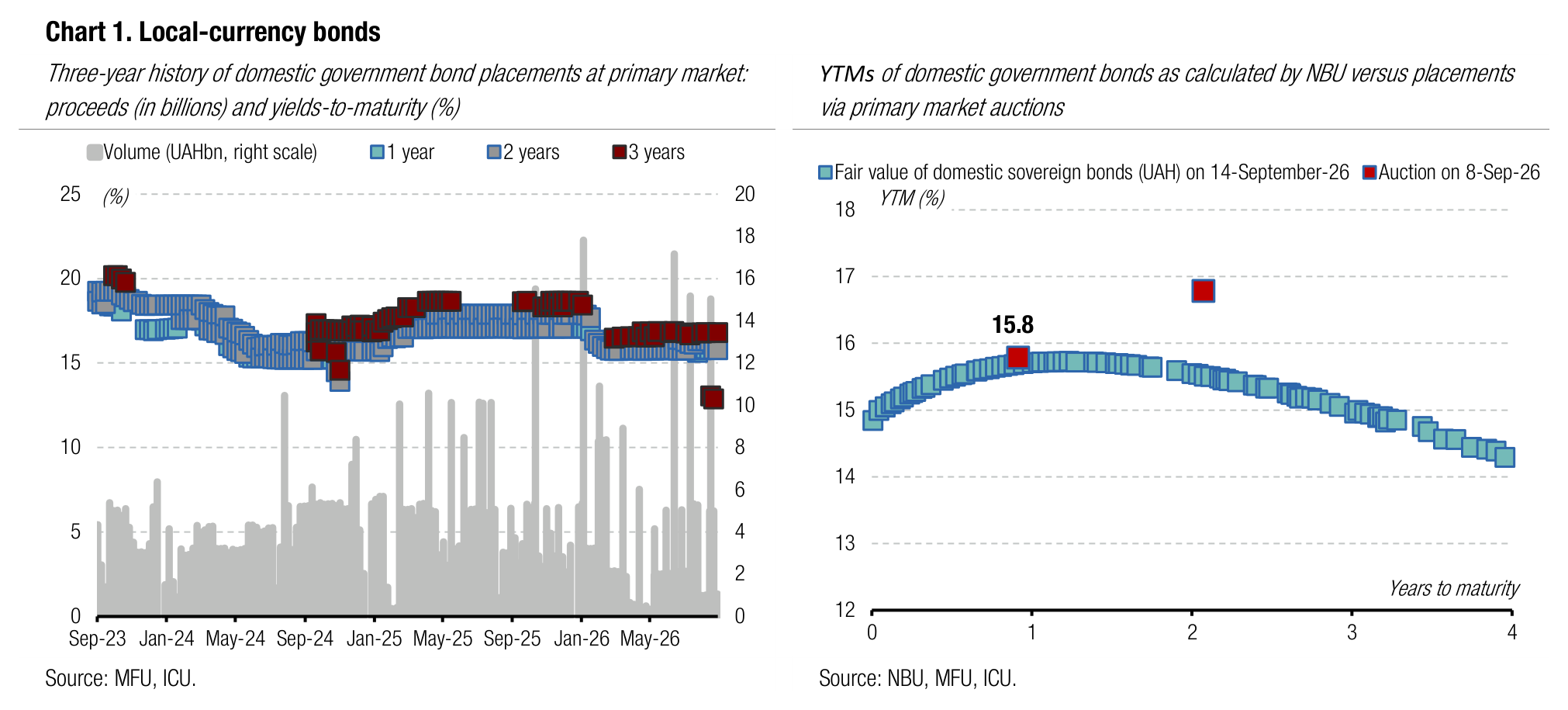
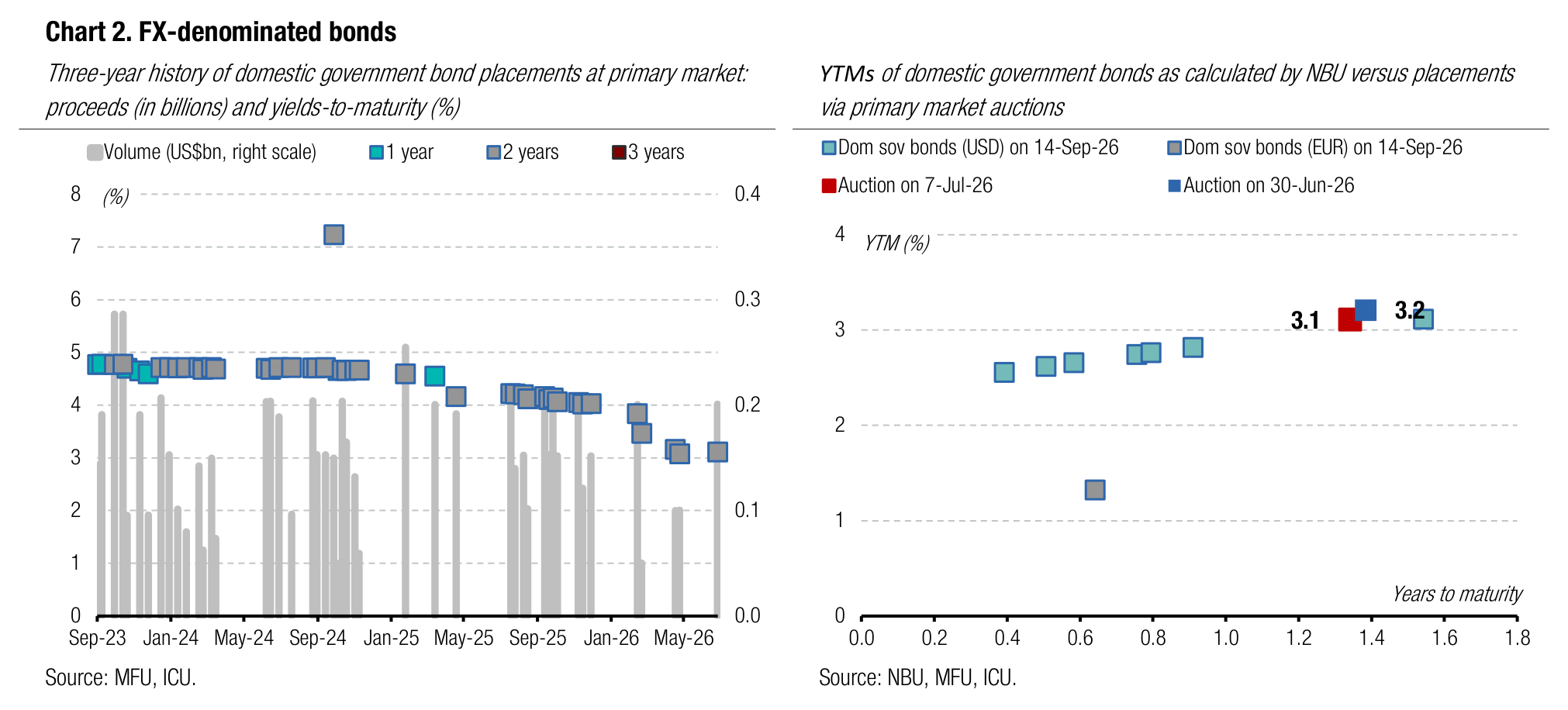
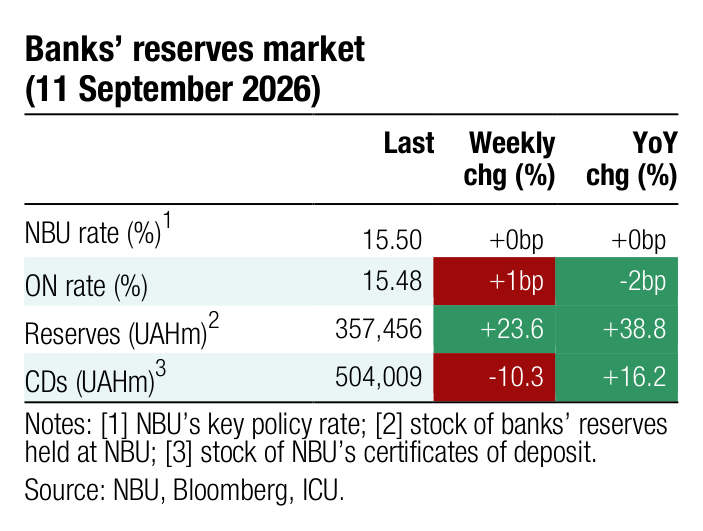
ICU view: The Ministry of Finance remains focused on two priorities: the rollover of reserve bonds and the safeguarding of the current yields of both military and regular bonds. Thus, the MoF continues to limit supply and reject bids that come in with higher yields. Despite the Ministry of Finance's recent statement that the state budget lacks sizeable amounts of funding for defence, there does not seem to be discussions about raising the target for domestic borrowings. Consequently, we do not expect the MoF will react immediately to a likely other 50bp hike (to 16%) of the NBU's key policy rate as soon as this Thursday. For 4Q26, the Ministry's borrowing plans will depend on the estimated funding gap and the prospects of patching that shortfall with international financial assistance. We assume that under certain circumstances, the domestic borrowing plan could be significantly raised during next budget revision process. Thus, the Ministry might have to start increasing yields on UAH bonds later into the year.
Foreign exchange market
NBU curbs hryvnia fluctuations
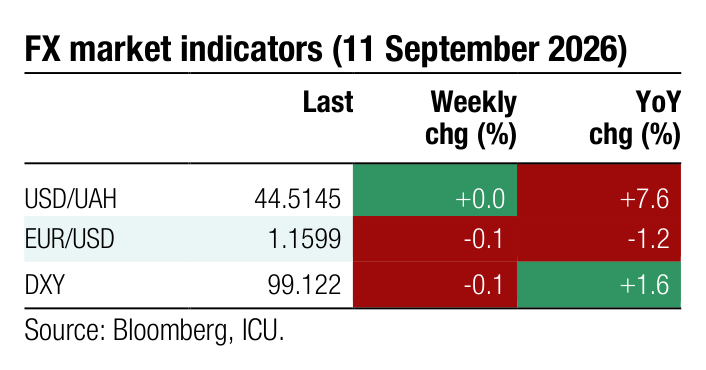
For three past consecutive weeks, the NBU has kept the official hryvnia exchange rate within a very narrow range, and last week, it also managed to reduce FX sale interventions.
Since late August, the NBU has allowed the official hryvnia exchange rate to fluctuate in the range of UAH44.5-44.7/US$ and only occasionally allowed it to dip below UAH44.5/US$. The holiday in the USA dampened FX trading last Monday, allowing the NBU to drop the official exchange rate to UAH44.3/US$ for the first since May.
The foreign currency deficit narrowed last week on lower demand in the interbank FX market, while supply remained almost unchanged. Net foreign currency purchases in the interbank FX market fell 22% WoW to US$656m, while in the retail segment it declined 12% to US$163m. This helped the NBU reduce its interventions by 10% to US$1.2bn, the lowest level in three weeks.
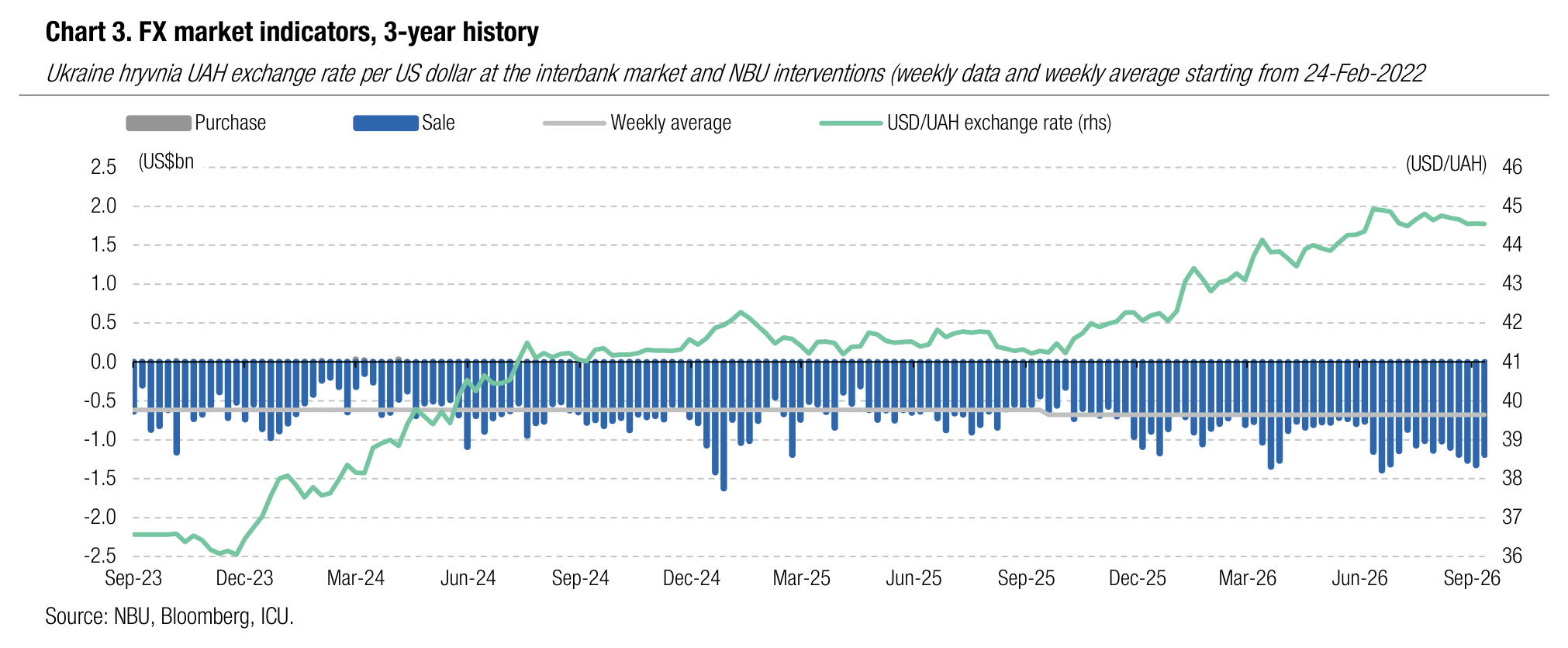
ICU view: The National Bank is currently preventing the US/UAH exchange rate from even approaching the UAH45/US$ mark. The NBU also continues to demonstrate that the hryvnia exchange rate can move in either direction despite the persistent significant foreign currency deficit in the market. Weekly hard currency sale interventions by the central bank over US$1bn have become the new normal on the back of reduced agricultural exports and higher imports of components for domestic weapon production. We expect the NBU to continue covering all excess demand for foreign currency without any limits to prevent a sharp devaluation of the hryvnia. Nevertheless, we forecast that the exchange rate could move toward UAH45.8/US$ by the end of the year.
Economics
NBU reserves slip below US$50bn again
The gross international reserves of the NBU declined 5.0% in August (-15.1% YTD) to US$48.7bn on lower inflows of foreign aid. The reserves were equivalent to 4.0 months of the future imports by the NBU estimates.
The NBU FX sales interventions remained very high in August at US$4.8bn – the third largest monthly size ever. Another $0.7bn was spent on the servicing of external debt. The replenishment of reserves was much smaller as Ukraine received a mere US$0.9bn in foreign financial aid during the month. Yet, the reserves were also supported with US$1.6bn of the defense component of USL (received in earlier months) that the government sold to the NBU to pay to local weaponry producers.
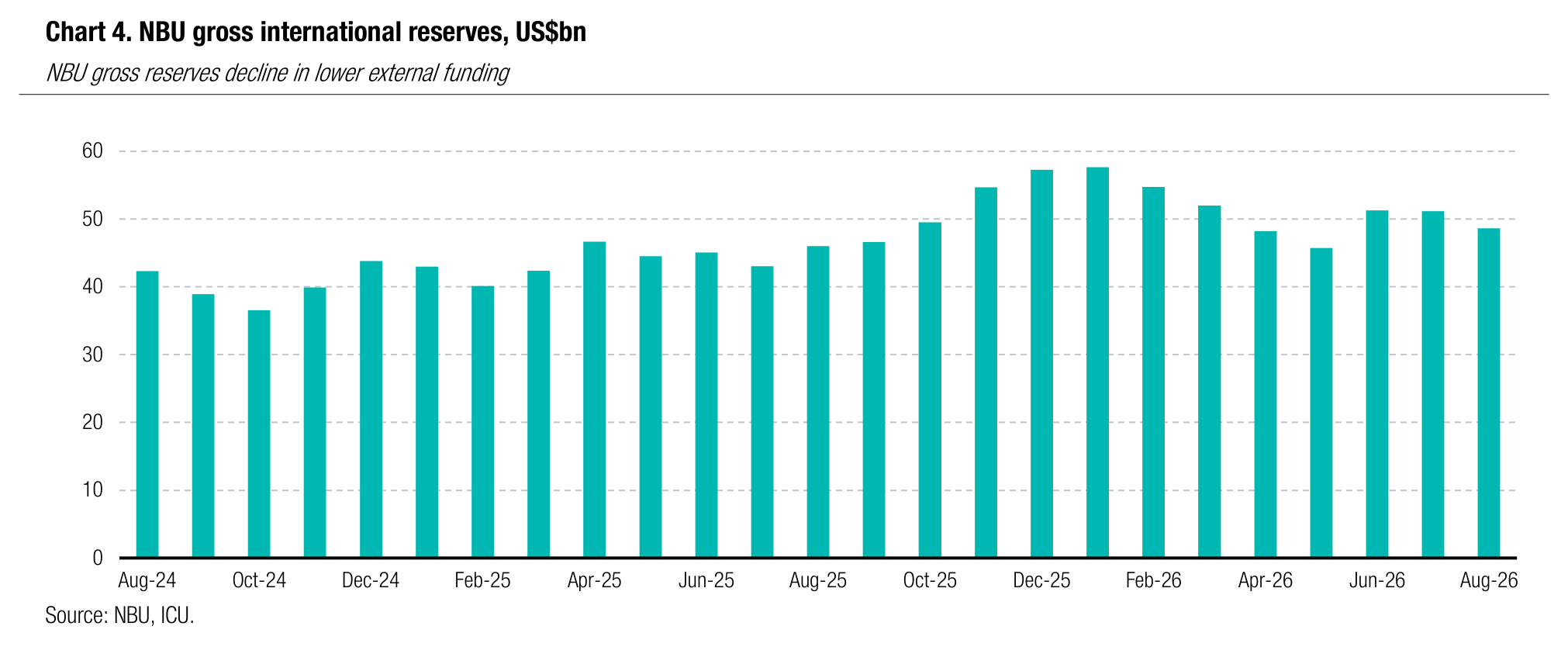
ICU view: The NBU reserves remain volatile due to uneven inflows of foreign financial aid. Our baseline scenario assumes over US$30bn in new grants and concession loans through the year end – all of which have been already committed but (a part of it) delayed due to slow legislative progress in Ukraine. We expect NBU reserves will land at close to US$60bn at end-2026, implying the central bank will remain in a sound position to keep the FX market under control at least in the next 12 months.
Inflation accelerates on fuel prices
Annual CPI picked up to 8.1% in August from 7.7 in July driven by fuel prices and utility tariffs. Core inflation was unchanged at 8.1% YoY.
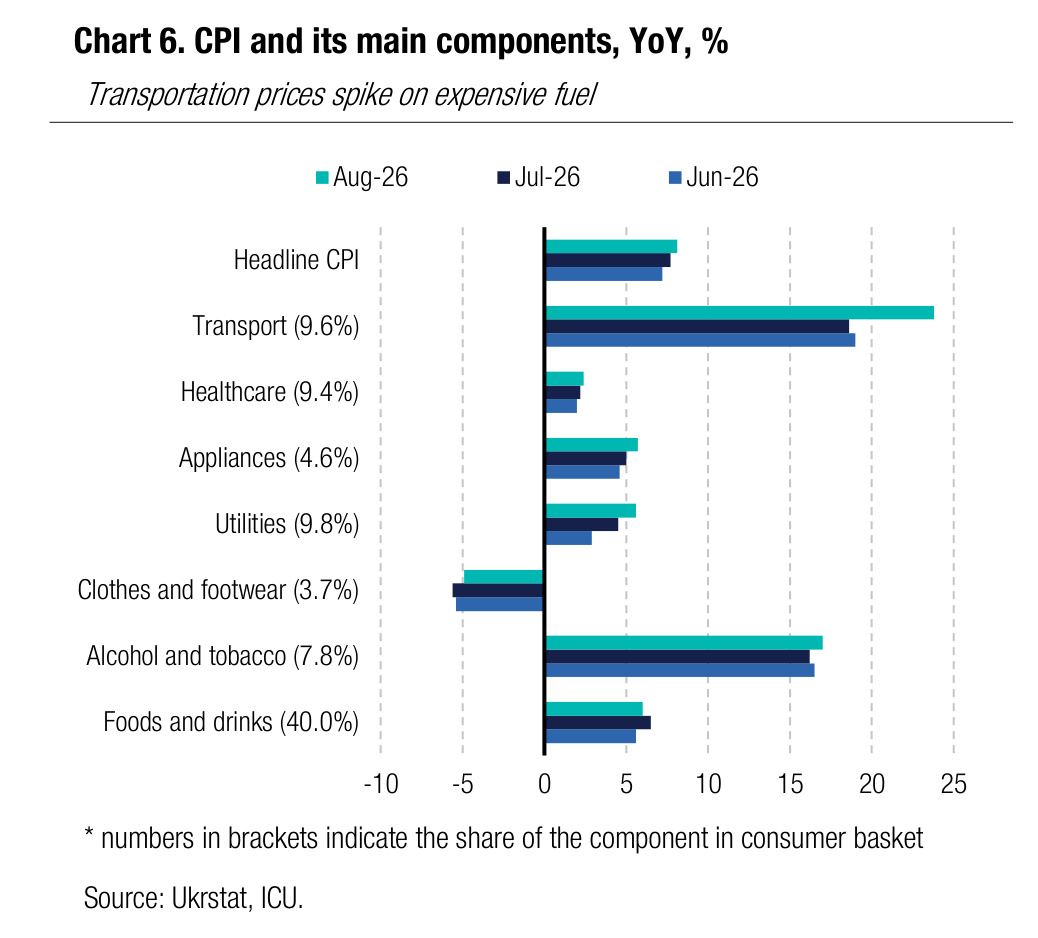
Monthly inflation stood at 0.1% last month, even though August normally marks disinflation on a decline of food prices. This year was no different for food prices as they declined 1.4% MoM (driven by fruits and vegetables) despite more expensive logistics due to russia’s terror attacks on infrastructure. In YoY terms, food price growth moderated to 5.9% from 6.4% in July. Yet, prices for several other important consumer basket components were substantially up, with transportation showing the most significant acceleration to 23.8% YoY vs. 18.6% in July, driven by more expensive gas and diesel. Two other important contributors were utility tariffs (+1.3% MoM and +5.6% YoY) and alcohol and tobacco (+1.5% MoM and +17.0% YoY).
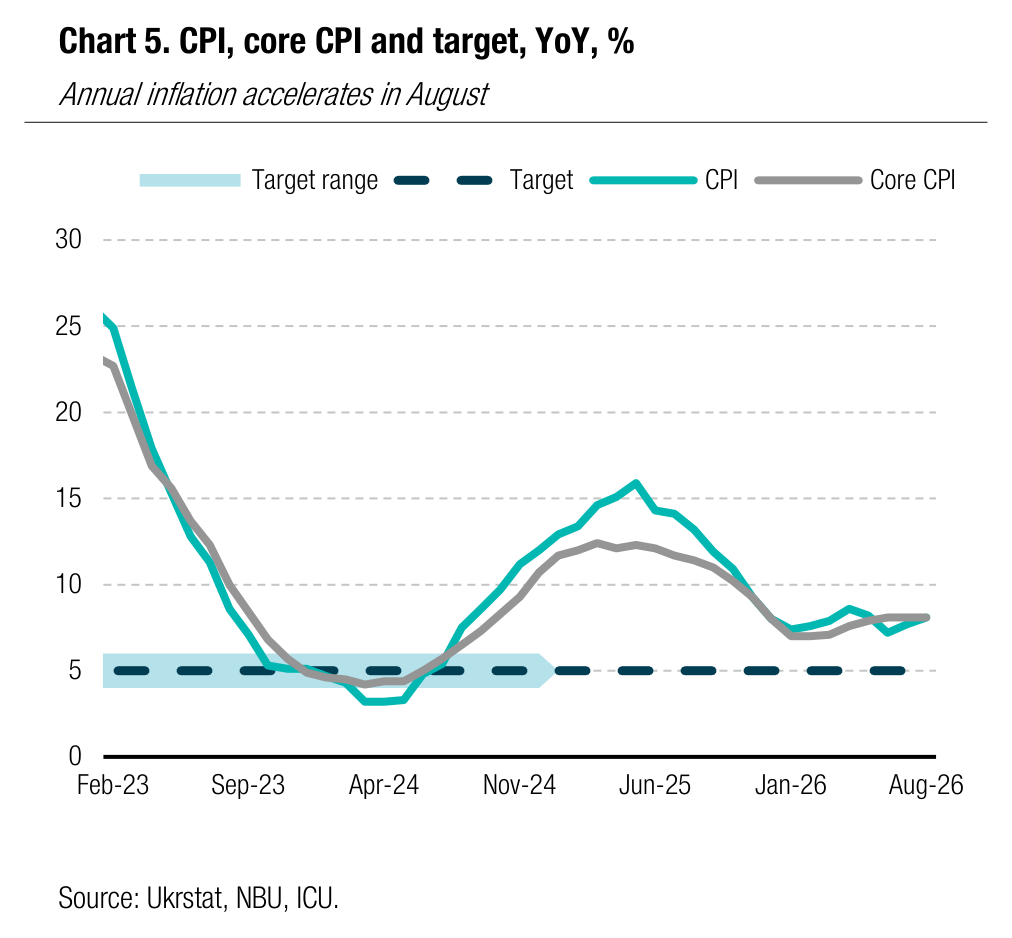
ICU view: Inflation remains on the rise, and we expect annual CPI will grow every month at least until December to reach nearly 10% at end-2026. Inflationary pressures will continue to stem from several sources, but will remain dominated by surging fuel prices and cost-side pressures on the back of mounting producer losses due to russia’s strikes on logistics and storage facilities. The counterbalancing factors will be an abundant supply of agricultural harvest that is being exported at a very slow pace and more cautious consumer behaviour due to higher economic uncertainly.