

Ukrainian bond market
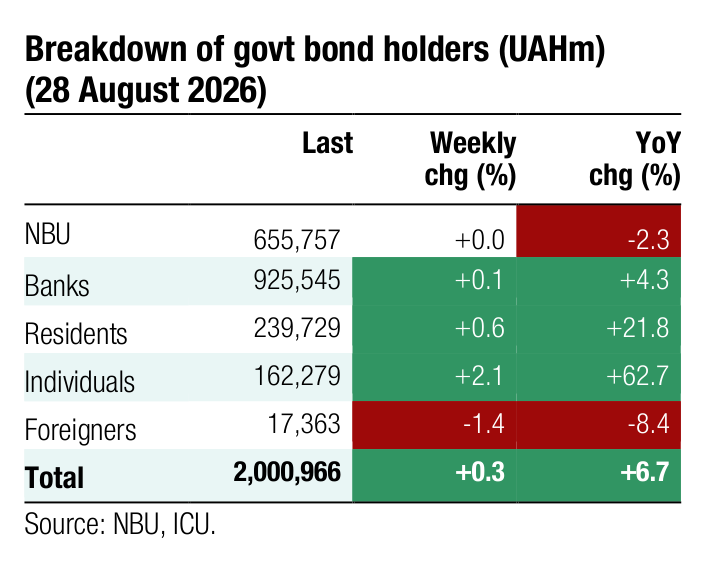
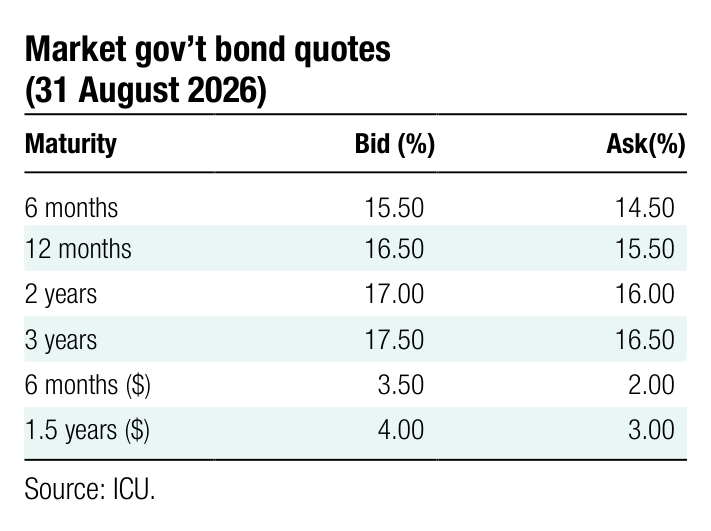
MoF slows debt refinancing in August
Following two summer months with positive net borrowings, the amount of debt the Ministry of Finance raised in August fell short of repayments.
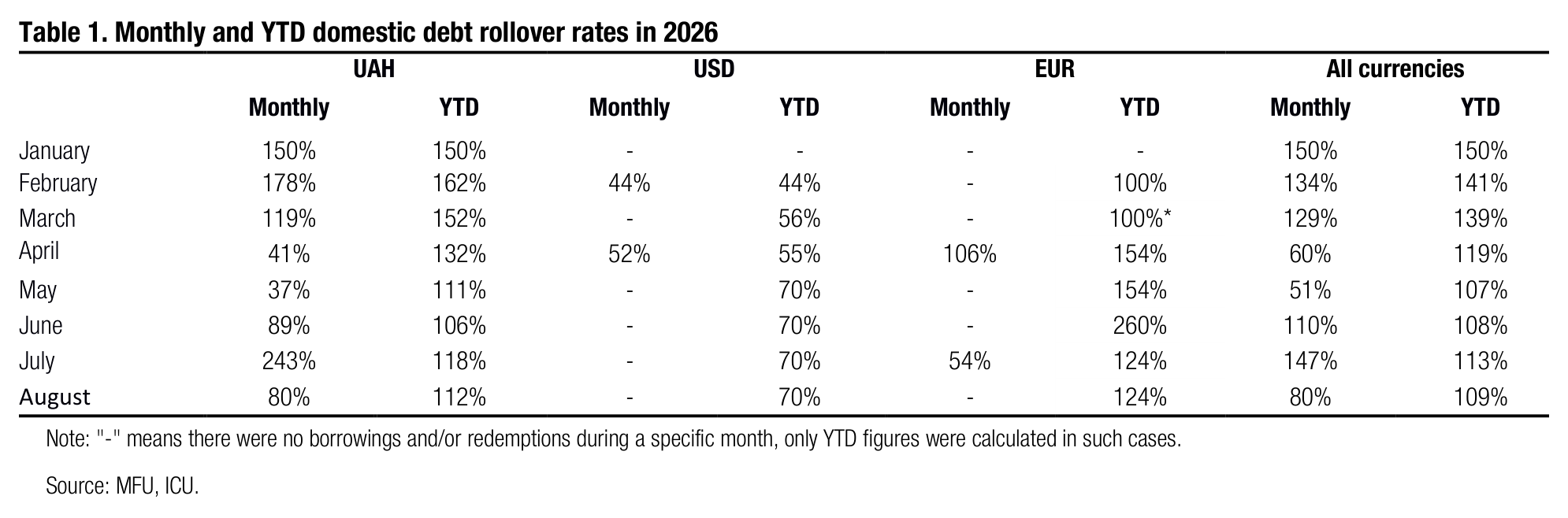
In August, the MoF issued and redeemed only UAH bonds, leaving the rollover in US dollars and euros unchanged vs 7M26 at 70% and 124%, respectively.
The Ministry of Finance was in no hurry to borrow in August and focused on reserve bonds. The MoF sold UAH5bn of new reserve securities in the first week of the month, and last week, the ministry sold more of the same security for UAH15bn to exchange it for the government bond maturing at the end of September. In addition, the Ministry of Finance placed UAH5bn of ordinary notes due in 2030, UAH2.9bn of bills due next year, and UAH2.7bn of 2028 bonds. In total, UAH32.6bn was borrowed, including the placements via exchange. At the same time, UAH40.6bn worth of UAH bonds was redeemed in August, including UAH14bn via exchange.
Thus, rollover of UAH debt amounted to 80% in August, pushing the YTD rollover down to 112% in 8m26, while the refinancing rate for domestic debt in all currencies stood at 109% in 8m26.
ICU view: The Ministry of Finance reduced the supply of the shortest bonds in August after the NBU raised the key policy rate, aiming to prevent a rise in bond yields. This approach is fully consistent with the goals of the current state budget law that envisages rollover below 100% for the full year. YTD, the state budget deficit has been almost fully covered with international financial assistance leaving an insignificant role for domestic borrowings. However, a likely upcoming revision of the state budget may include an increase in the domestic borrowing plan, prompting the Ministry of Finance to adjust volumes and yields of the bond offerings in the primary bond market.
Foreign exchange market
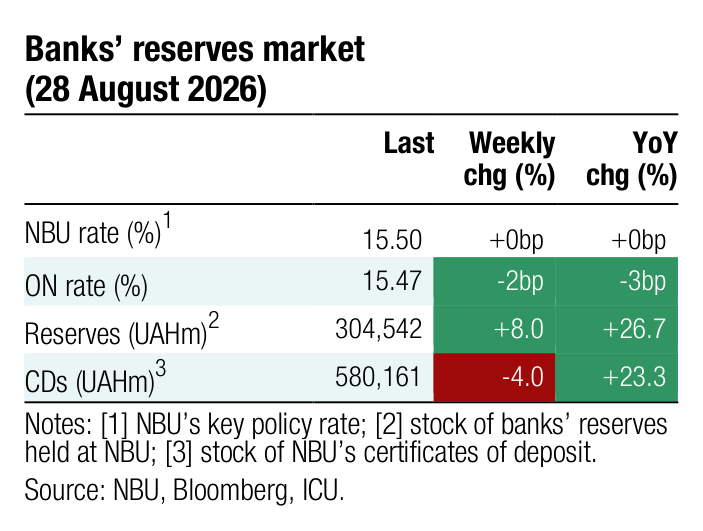
NBU interventions back at peak again
NBU interventions increased last week and approached peaks seen during the full-scale russia invasion.
During the full-scale war, the weekly interventions were the largest at the end of May 2022 (over US$1.4bn), in the last two weeks of 2024 (over US$1.4 and US$1.6bn), and in the last two weeks of June this year (almost US$1.4 and US$1.3bn). Interventions were significantly lower in other weeks with an average weekly volume during the full-scale war at US$671m. Yet, in July, NBU interventions consistently exceeded US$1bn again and approached US$1.3bn recently.
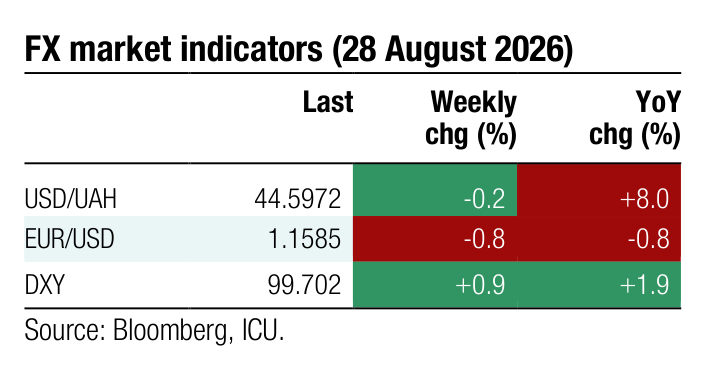
Higher NBU interventions helped keep the hryvnia rate under control and strengthen the local currency. The official hryvnia exchange rate against the US dollar was up by 0.2% to UAH44.55/US$ since the beginning of August, while the US dollar appreciated vs the hryvnia by 5.2% YTD.
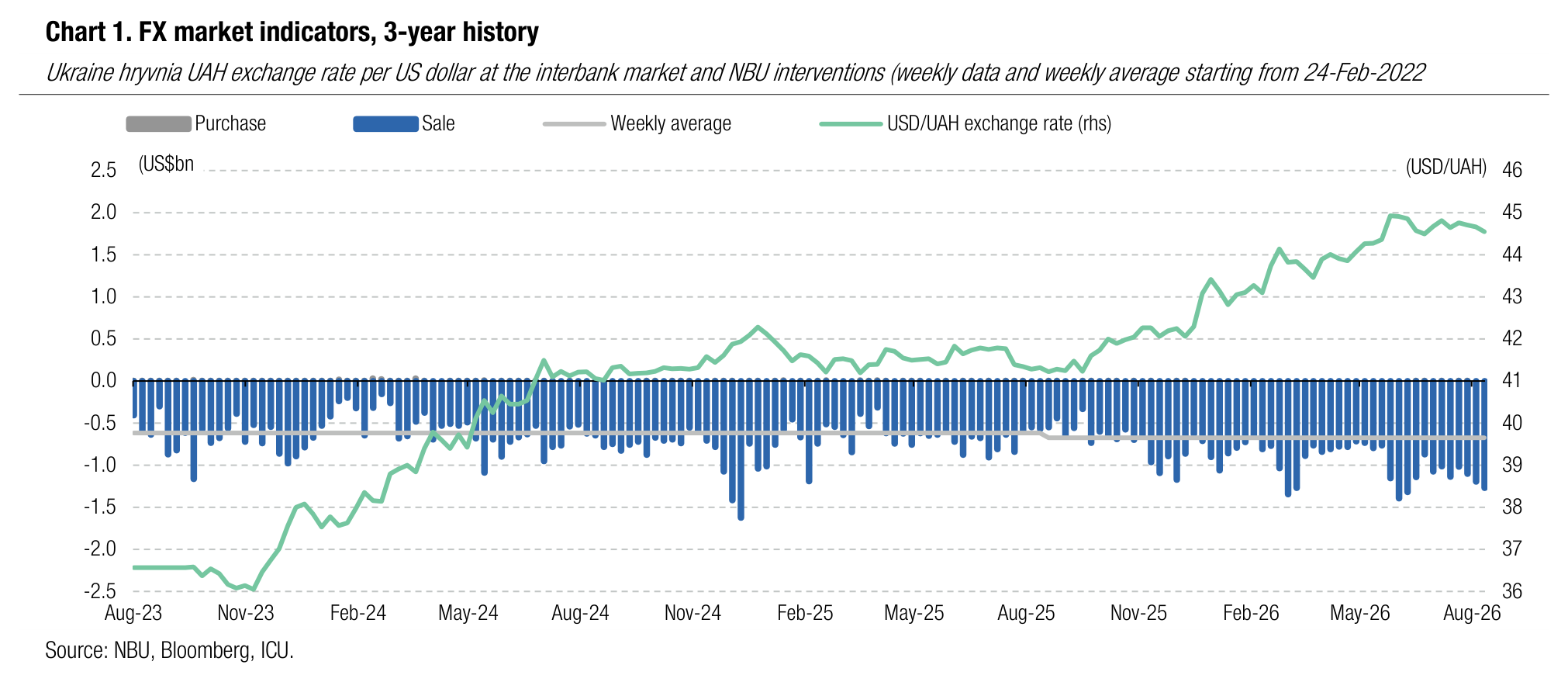
ICU view: The National Bank signalled it considers interventions close to US$1bn acceptable, as they are justified in the current circumstances. Ukraine has recently seen a significant reduction in exports due to the damages to port infrastructure. Ukraine also had to increase the import of weapons and components for domestic military production that is being financed with the defence part of USL loan from the EU. Meanwhile, the NBU seeks to maintain the attractiveness of hryvnia assets and aims to keep hryvnia fluctuations vs the US dollar in a relatively narrow range. We expect the needs for interventions to continue growing, pushing FX sales by the NBU to new historical highs in the coming months. Also, looking through end-2026, we expect the central bank will need to weaken the hryvnia occasionally, and we see UAH/US$ rate at 45.8 by the end of the year.