
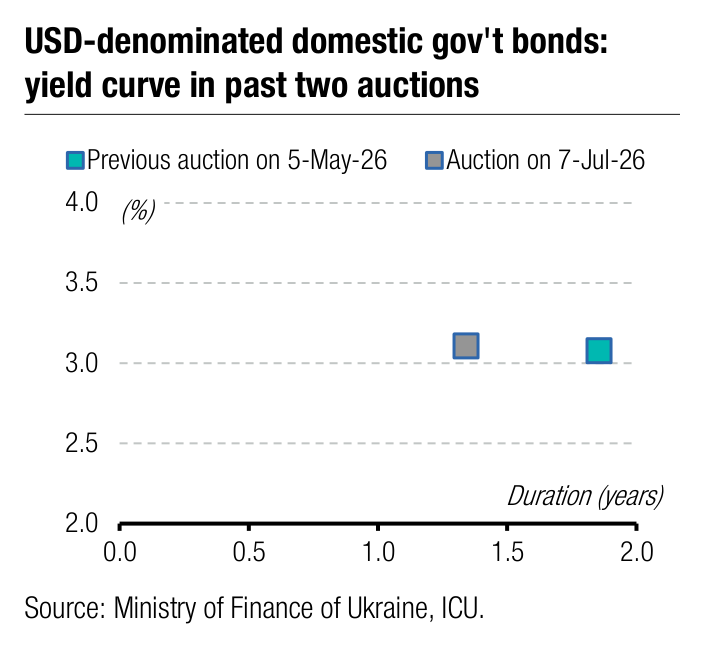
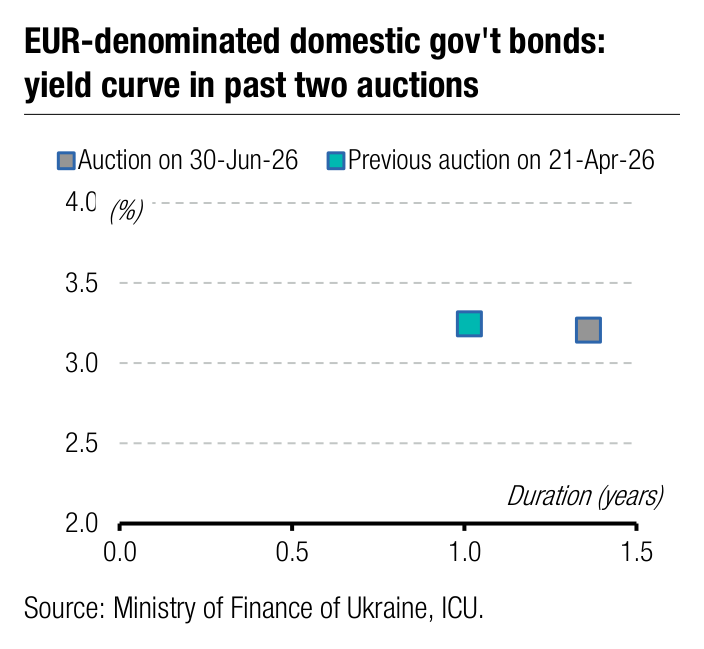
At yesterday's auction, UAH government bond yields did not show any significant changes, suggesting a calm reaction from market players, with yields moving differently across instruments.
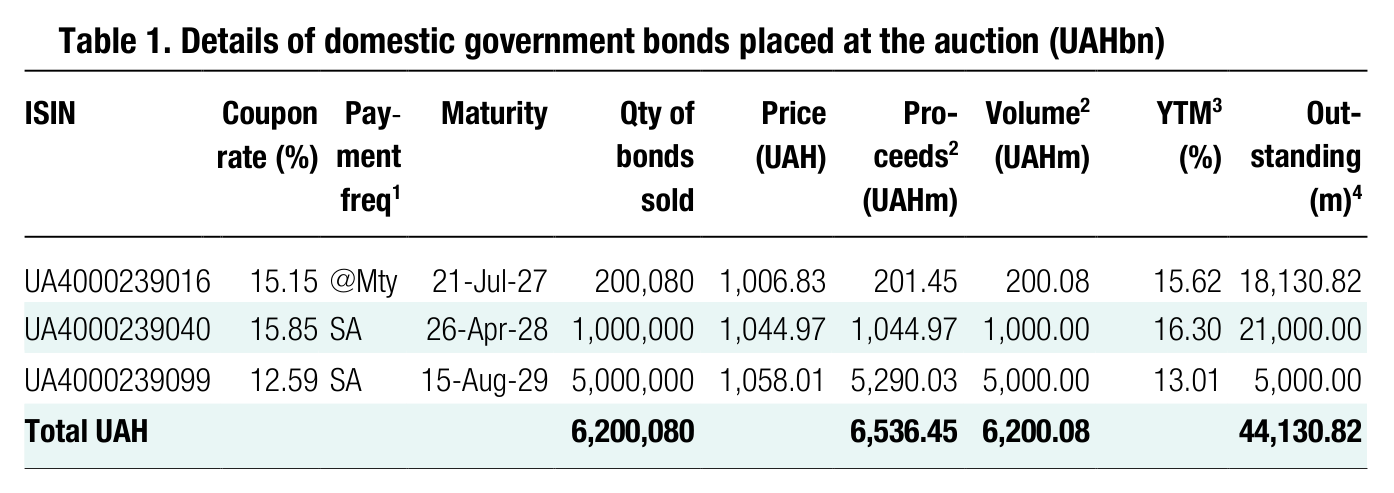
Note: [1] payment frequency abbreviations: M - monthly, Qtly - quarterly, SA - semi-annually, @Mty - at maturity date; [2] proceeds and volumes for the USD-denominated bonds are calculated based on the previous day's exchange rate 44.48/USD, 51.04/EUR; [3] yields on coupon-bearing bonds are effective yields to maturity. Sources: Ministry of Finance of Ukraine, Bloomberg, ICU.
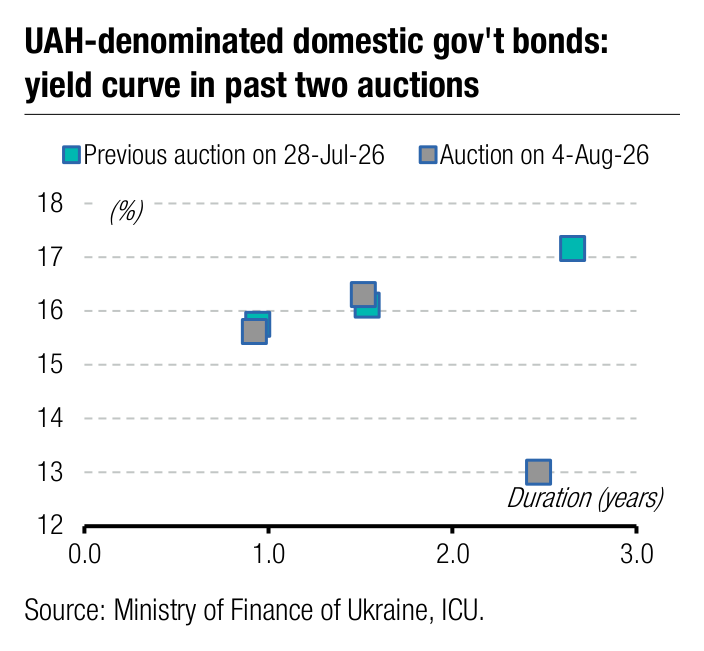
For the one-year paper, rates even hinted at a possible decrease. The Ministry of Finance received 13 bids for a small amount, a little above UAH200m. The maximum bid rate remained at 15.15%, while the minimum rate decreased by 1bp to 14.99%. It is likely that most of the demand was for yields closer to the minimum rate, as the weighted average decreased by 12bp to 15.01%. This indicates that demand was likely from retail and corporate clients.
At the same time, yields on 1.8-year paper increased. However, this can only be called an increase if compared with the auctions in July, and not looking at the slightly longer history of placements of bonds with a maturity of two years. The MoF placed these securities from April until almost the end of May, and their yield was 15.87%. Only from the end of May, when the Ministry replaced regular government bonds with military paper, did demand exceed supply, ultimately causing yields to decline to 15.53% (cut-off rate) and 15.46% (weighted average) by the end of July. Yesterday's rate increase can be seen as a correction or a gradual move to normal rate levels. And if we compare it with the end of July, then yesterday we had an increase in the cut-off rate by 12bp to 15.65% and the weighted average rate by 18bp to 15.64%. However, if compared with April, the yields are even lower by 22bp and 21bp, respectively.
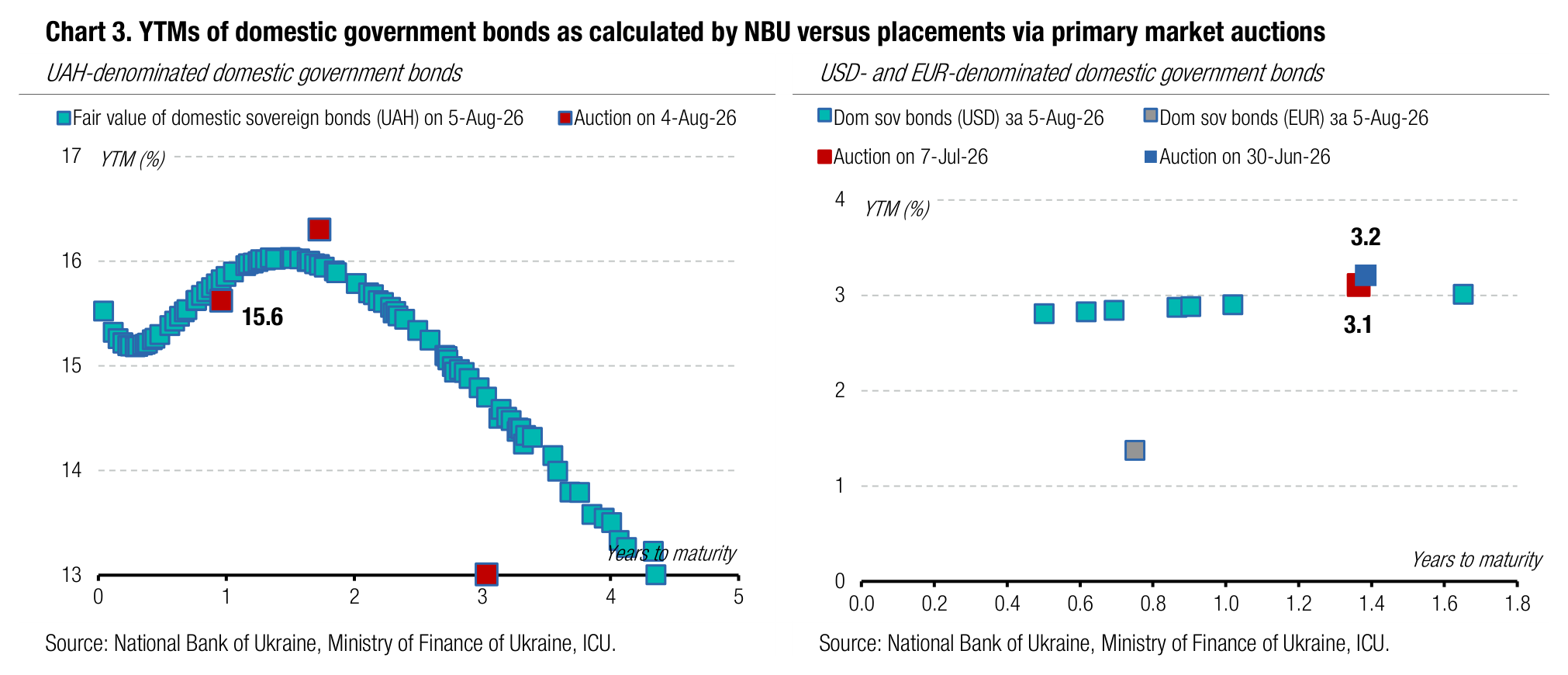
The Ministry of Finance also placed the first tranche of a new reserve note. These are securities with a maturity of three years, and it is for them, later in August, that the MoF will offer to exchange reserve government bonds with a maturity of September this year. The yields on the new securities yesterday were even lower than those on the July issue of reserve bonds, but their maturity is five months shorter. The cut-off rate is set at 14bp lower, and the weighted average rate is 16bp below that for the July issue, at 12.69% and 12.59%, respectively. That is, it is inappropriate to talk about any changes in the conditions.
So, in general, the MoFs and market reaction was very restrained. Primary dealers and their clients were in no hurry to submit bids with yields up 50bp to the July interest rates (although the maximum rate in bids for two-year securities increased by 35bp WoW), and for reserve bond, the maximum rate fell by 196bp WoW. At the same time, the MoF did not insist on maintaining the levels seen at the end of July; a few months earlier, yields on the two-year issue were even higher, leaving room for manoeuvre, especially with even smaller caps.
Appendix: Yields-to-maturity, repayments