

Ukrainian bond market
MoF keeps bond yields unchanged
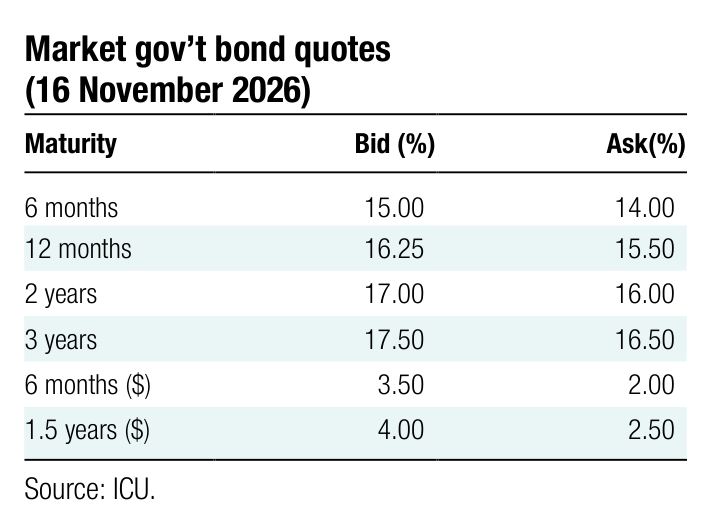
Last week, the Ministry of Finance rejected requests for higher yields at the primary auction and reaffirmed its reluctance to move interest rates up on UAH bonds after the NBU key rate hike.
For the fourth consecutive month, the MoF kept yields on UAH bonds flat, while steadily moving toward meeting its full year borrowing target. The budget law envisages 2026 domestic borrowings of nearly UAH420bn. By the end of July, when the National Bank of Ukraine started its policy tightening cycle, the MoF still needed to raise approximately one- third of this amount (UAH120bn, including "reserve" bond exchanges). Over the 3.5 months since July, the MoF raised UAH99.4bn via UAH bonds: UAH63.5bn via reserve notes (including exchanges), and UAH35.9bn via "military" and regular bonds.
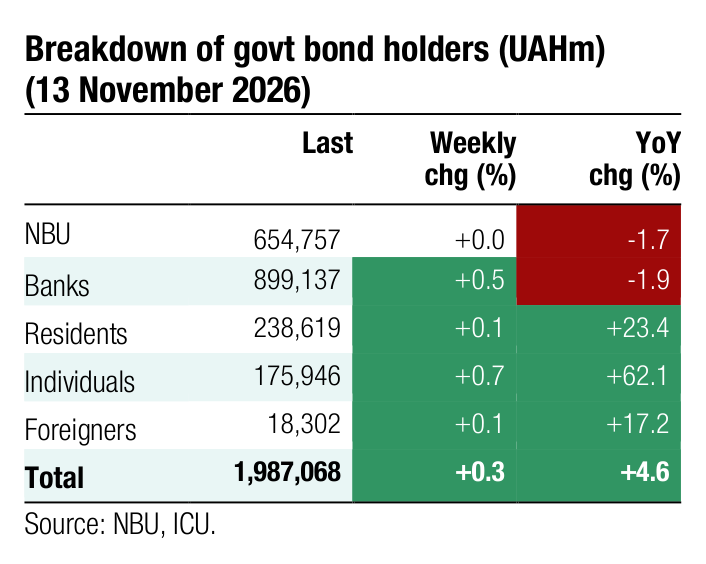
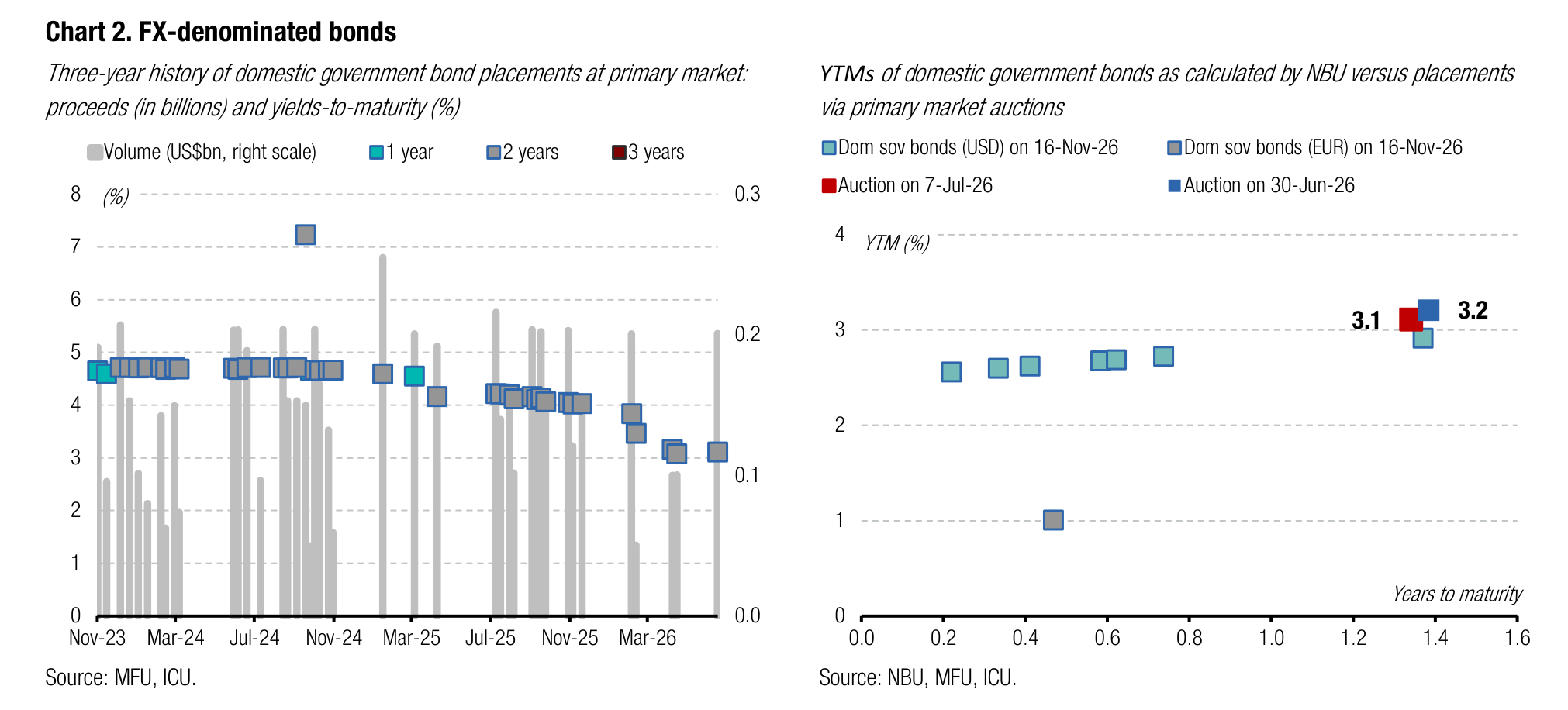
Those regular and military bonds eventually made their way to retail portfolios, as retail investors seem to be fully satisfied with the level of yields established over the summer. These yields provide sufficient compensation for both inflationary and FX risks. The Ministry of Finance is likely targeting this type of investors by offering regular and military bonds, while offers for banks are focused on reserve bonds. As of today, by our estimates, the MoF raised nearly UAH399bn in all currencies, leaving just below UAH21bn to be raised to meet the annual plan. The MoF plans to offer EUR200m of FX-denominated paper tomorrow, and, if successful, this will halve the remaining borrowing plan. Thus, over the next six weeks (including tomorrow's auction), the Ministry of Finance will need to borrow less than UAH1bn per week, or otherwise conclude its issuance program ahead of schedule.
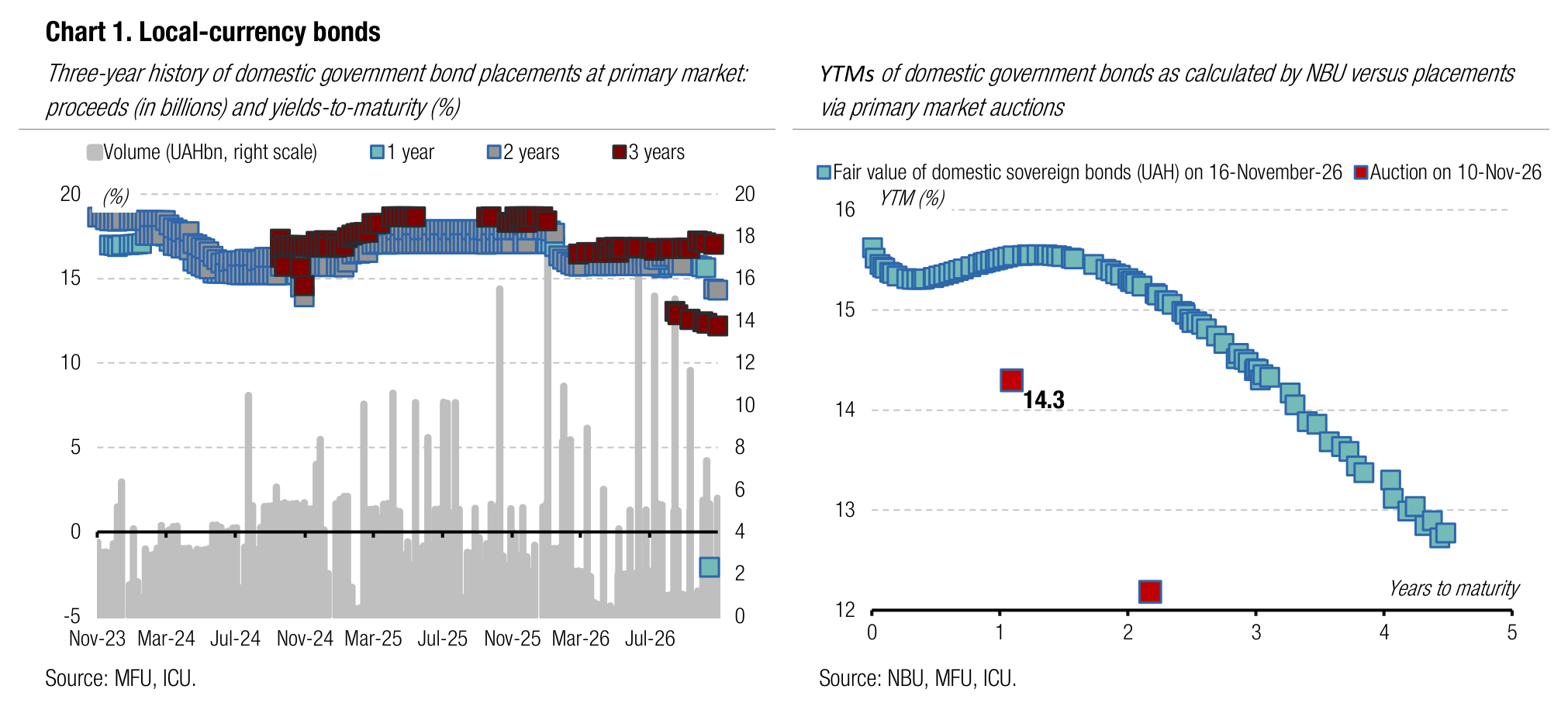
ICU view: The Ministry of Finance has no incentive to increase yields on UAH bonds this year. Retail investors will likely maintain their interest in the paper. The MoF's approach early next year will depend on the budget's funding requirements. The mid- term debt strategy and the budget draft for 2027 envisage only a 100% rollover of domestic debt. Most likely, the Ministry of Finance will seek to maintain current yields on UAH securities and continue issuing bonds with maturities of at least one year. In doing so, it will take account of the expected trajectory of the key policy rate, which the NBU currently anticipates to start cutting in 2Q27.
Peace negotiations ignite little optimism
Following a long hiatus, the first round of the new series of Ukraine peace talks took place last week. However, it had little impact on the sentiment of Ukrainian Eurobond holders.
A new round of talks was held last Tuesday and Wednesday in the UAE, but yielded no significant results. The parties agreed to a prisoner exchange and a potential inclusion of European representatives in the existing trilateral format (US–Ukraine–russia). The next meeting could take place later this week or next week.
The resumption of the negotiation process after a long pause that began in February did not shift bondholders' sentiment. The securities continued to trade in line with broader emerging- market trends, with prices declining by an average of 1% last week, mirroring the EMBI index drop of 0.9%.
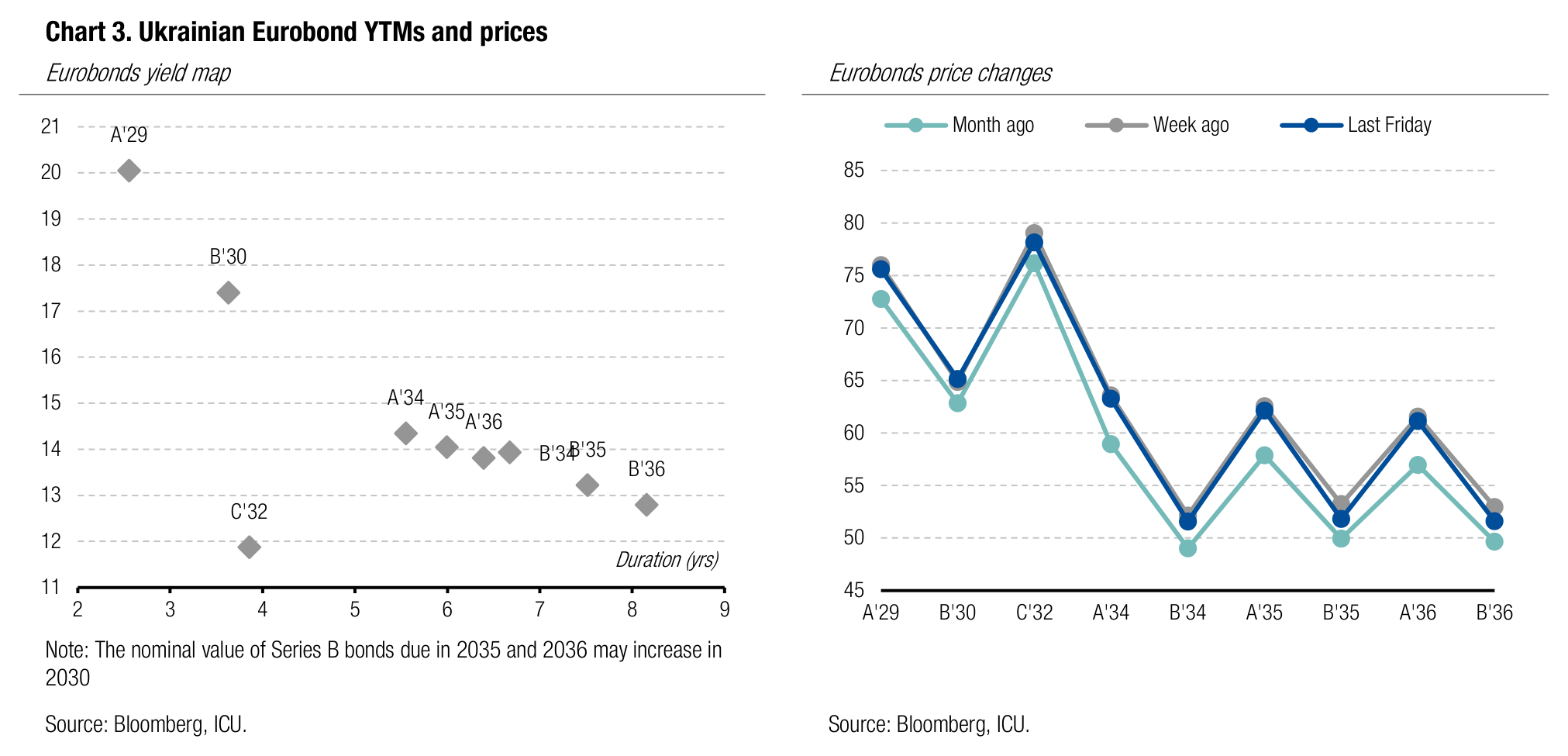
ICU view: Unlike in previous similar episodes, investors displayed little optimism regarding the prospects for the negotiations. Despite official statements that a tangible result could be reached before year-end, bondholders remained cautious and were in no rush to revise their valuation of the Eurobonds. A trilateral meeting between the leaders of russia, the US, and China is scheduled this week. Although the war in Ukraine is not on the official agenda, russian officials have indicated that putin intends to raise the issue. Most likely, this meeting will pave the way for the next round of trilateral—or perhaps quadrilateral—negotiations. However, we do not anticipate any breakthrough in the talks at this stage. russia is clearly putting forward demands that neither Ukraine nor its European partners are prepared to accept.
Foreign exchange market
NBU maintains high FX sale interventions
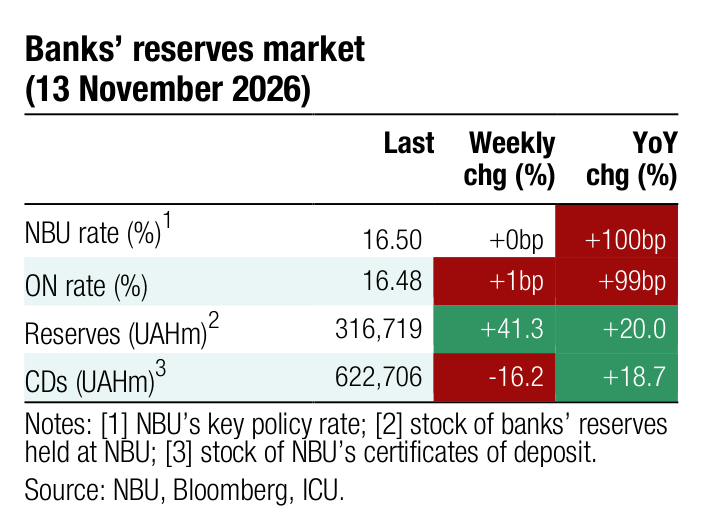
NBU's interventions remain near historic highs, as the NBU seeks to stabilise the market and prevent a further sharp devaluation of the hryvnia.
Last week, the overall foreign currency deficit narrowed to US$1.3bn. This decline was driven by a nearly 1/3 fall in net FX purchases by households—to US$354m (over four business days)—despite a slight increase in net purchases by bank clients (legal entities) to US$959m.
To meet this client demand and allow banks to replenish their FX accounts, the NBU sold almost US$1.8bn over the week.
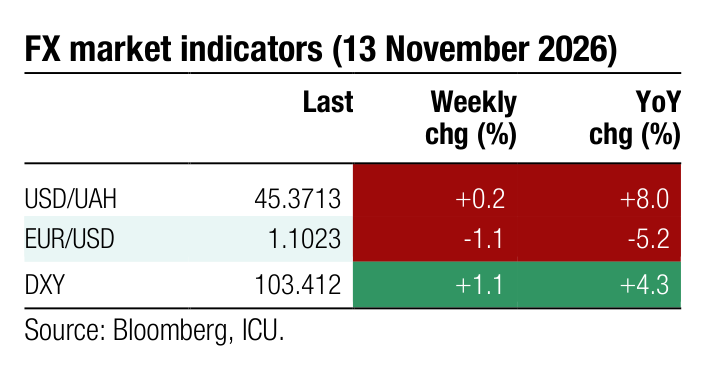
Through these interventions, the NBU kept the USD/UAH exchange rate within UAH45.32– 45.5/US$ range. Over the week, the official hryvnia exchange rate weakened by 0.2% to UAH45.43/US$ and 7.3% YTD.
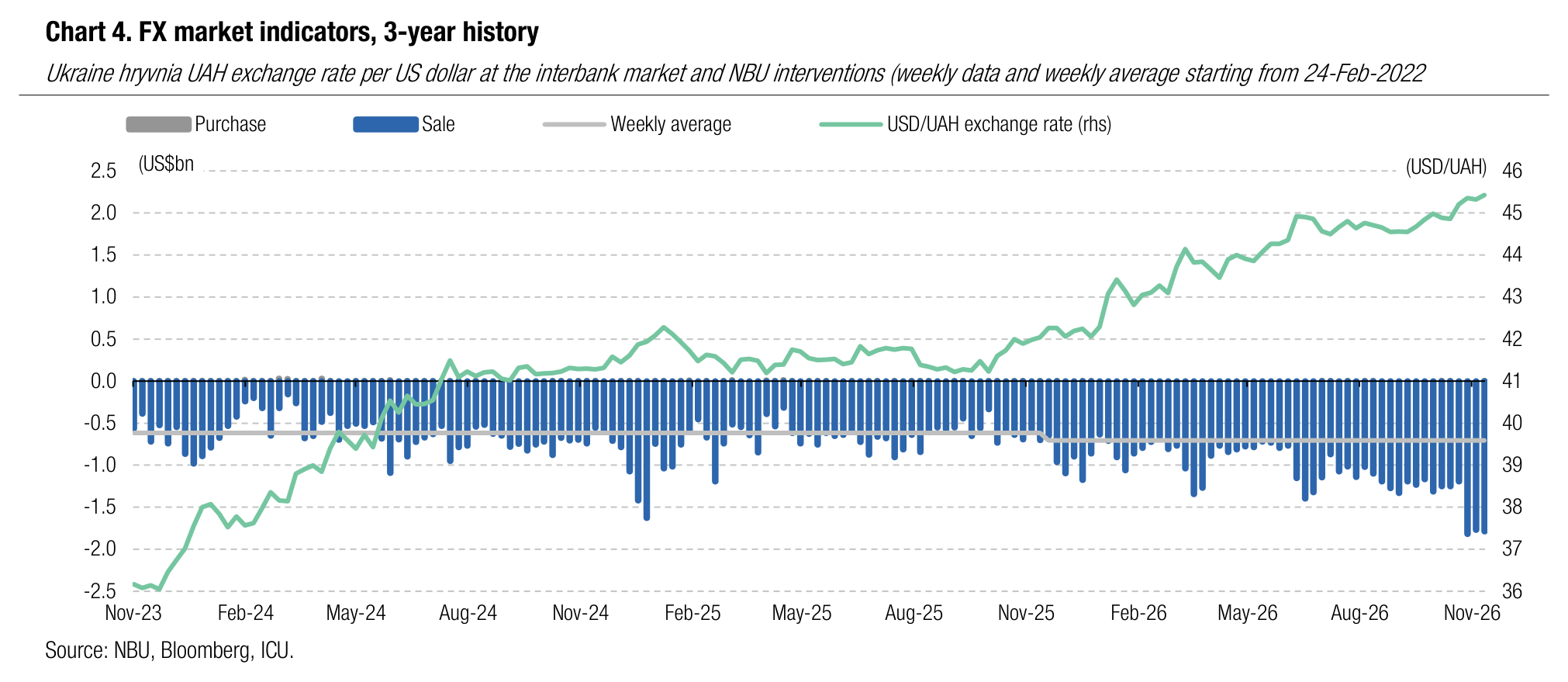
ICU view: The NBU is compelled to maintain a very high level of interventions due to a significant structural FX market deficit. This deficit is driven by expenditures on import components of domestically produced weaponry—funded through the USL program— and by a decline in export revenues due to logistical complications. Currently, the market is still digesting the effects of FX market turbulence in late October and early November. The National Bank managed to ease market concerns and may slightly reduce interventions in the coming weeks, but they will remain well above averages of the summer months. FX demand may be re-enhanced with a hike of budget expenditures that is a typical pattern for year-end. We do not expect the NBU to allow the hryvnia to weaken further significantly, and we maintain our year-end forecast at UAH45.8/US$.
Economics
Inflation gains pace
Annual CPI accelerated further to 11.0% in October from 10.0% in September, the acceleration was broad-based. Core inflation was up to 9.7% YoY from 8.8% in September.
Monthly CPI decelerated to 1.8% from 2.1% in September, but was well above October prints in previous years. Like in previous months, the pickup in price growth was seen across nearly all components of the consumer basket, with the only exception being tobacco and alcohol price growth for which was marginally down. Prices for fuel saw the largest impulse with annual growth accelerating to 53.9% from 46.2% in September. Prices for food, the largest consumer basket component, grew 2.0% MoM and 9.2% YoY, up from 8.9% YoY in September.
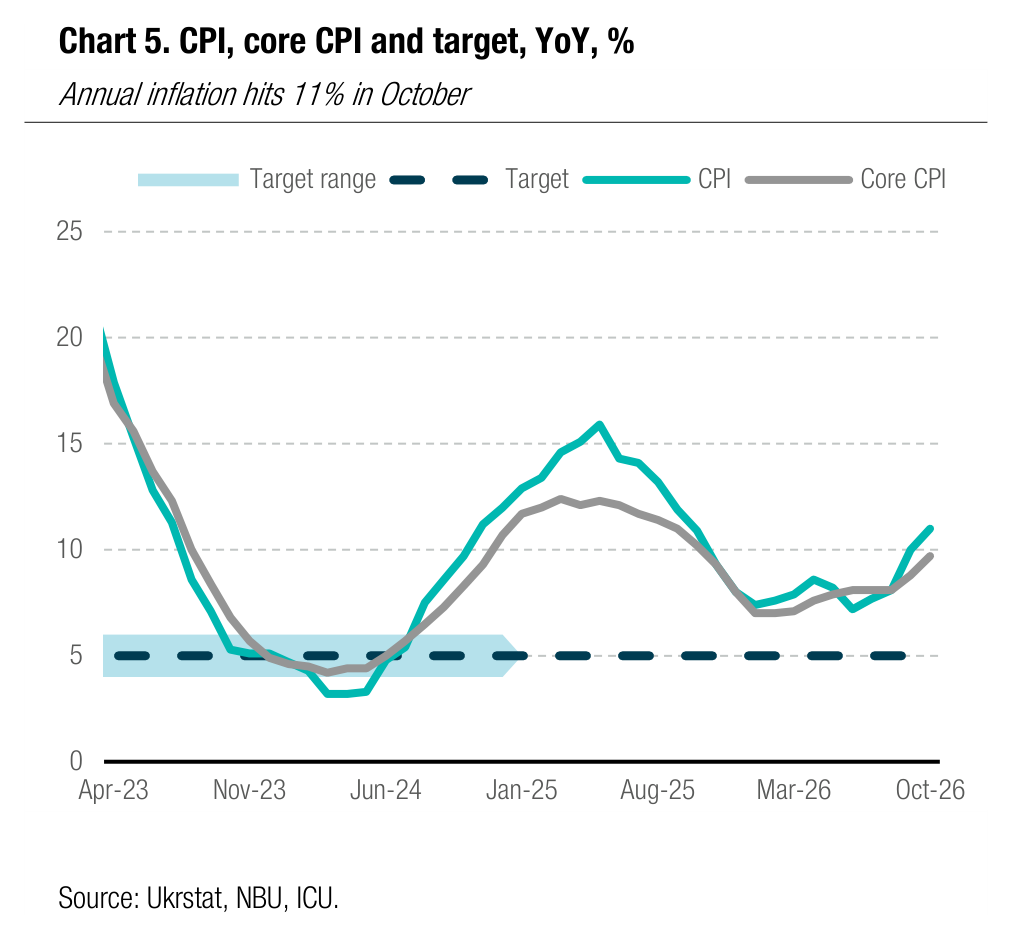
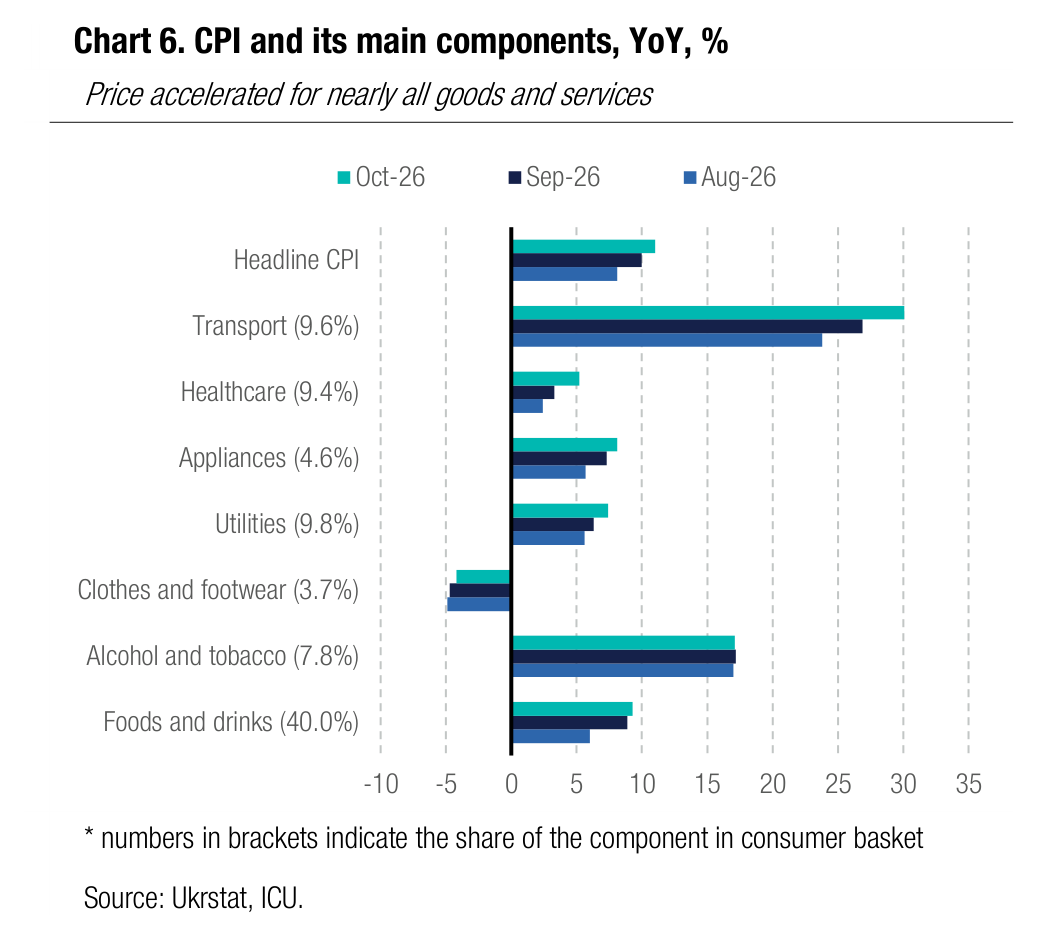
ICU view: October data signal the inflationary pressures are broad-based. While there are numerous drivers behind the trend, we believe the logistics complications and loss of production assets by many businesses due to russia’s attacks on civil infrastructure are the key contributors. Other factors include cost-side pressure related to surging salaries amid a tight labour market and higher energy prices. We expect inflation to reach 12% YoY by end-2026 and will remain in double digits at least until 3Q27. This will cement the NBU’s tight monetary policy, and we expect the current 16.5% key policy rate to remain intact at least until next June. At the same time, we see little chance of the NBU adopting one more hike as the current monetary policy stance seems fully appropriate.