

Ukrainian bond market
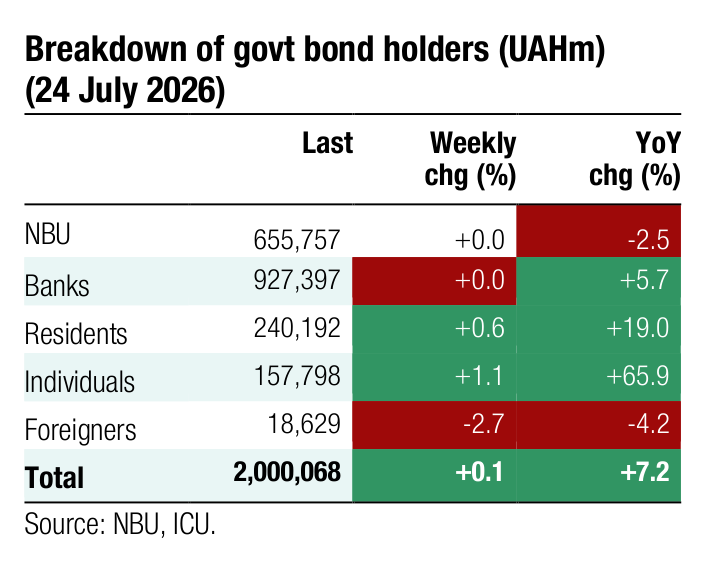
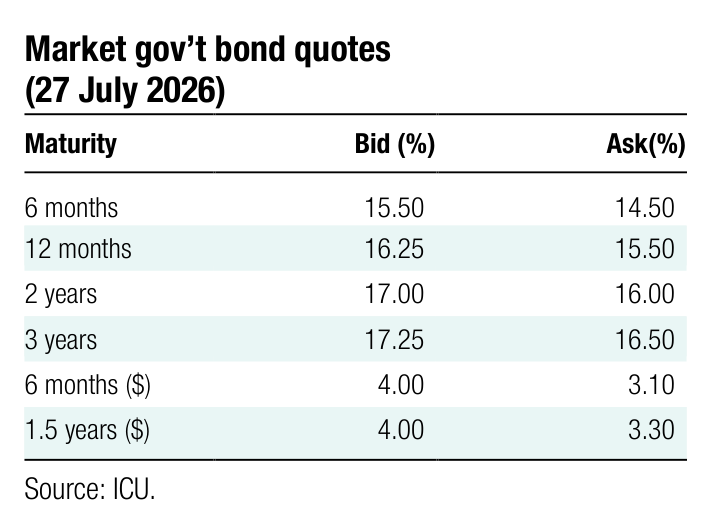
New bond exchange auction from MoF
The Ministry of Finance continues to swap reserve bonds with near maturities for new three- year notes.
The MoF has been actively exchanging reserve bonds ahead of their maturities since the start of June. Overall, five reserve bonds for a total of UAH99bn are due by the end of the year. Back in June, the ministry exchanged most of the reserve bond that was due last week, and then redeemed the remaining part of this paper. At the auction last Wednesday, most of the securities maturing next week were exchanged for a new three-year note due in December 2029.
Last week's exchange auction saw nine bids for over UAH15bn, just above the supply cap. That allowed the MoF to exchange approximately 70% of the paper maturing on August 5. Yields were nearly unchanged vs those on the primary placement two weeks earlier.
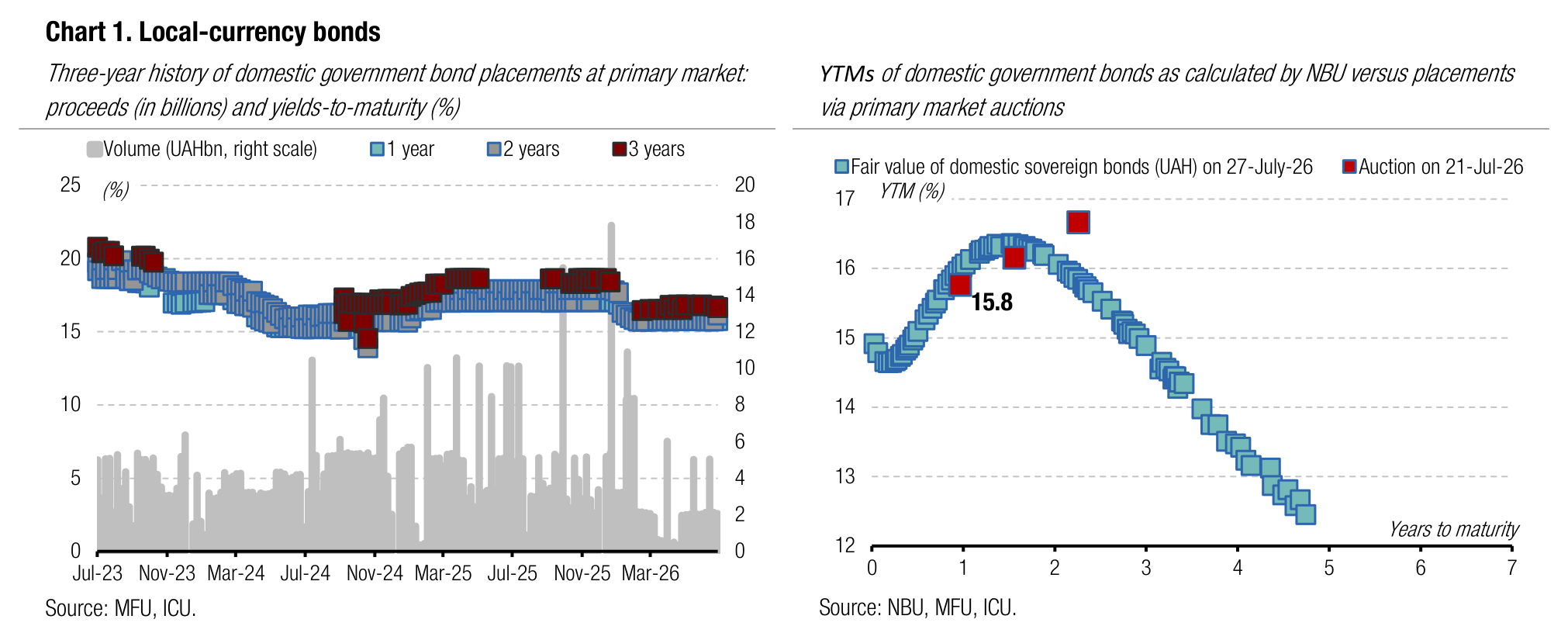
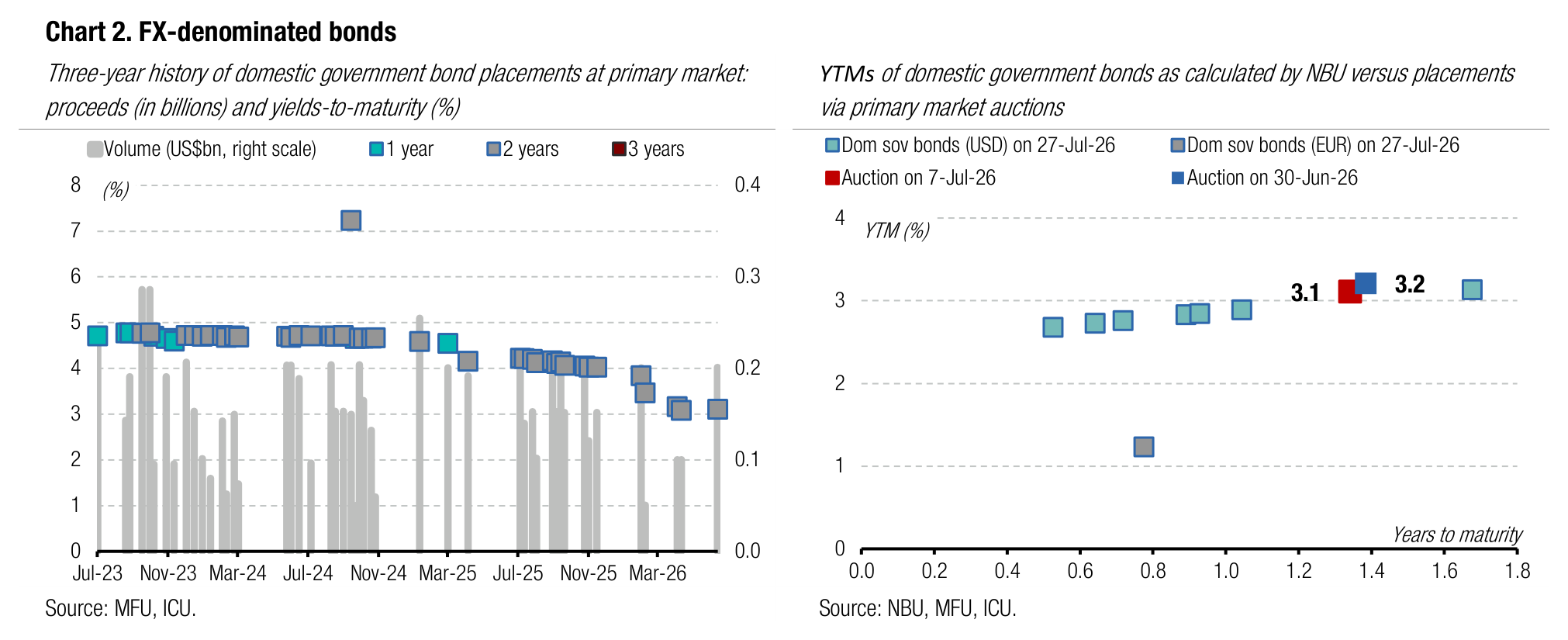
ICU view: The Ministry is sticking to a consistent and clear policy and keeps exchanging bonds with near maturities for new securities with significantly longer tenors. Last week saw the seventh exchange auction YTD, and we expect at least three more by the end of the year.
Eurobonds fall sharply
Ukrainian Eurobonds fell sharply last week, with the decline rate significantly exceeding that of other emerging markets securities.
Over the past week, the EMBI index slid by 0.9% to a two-month low in response to the latest round of escalation of the war in Iran. Ukrainian Eurobond prices declined much more substantially, on average by almost 3%.
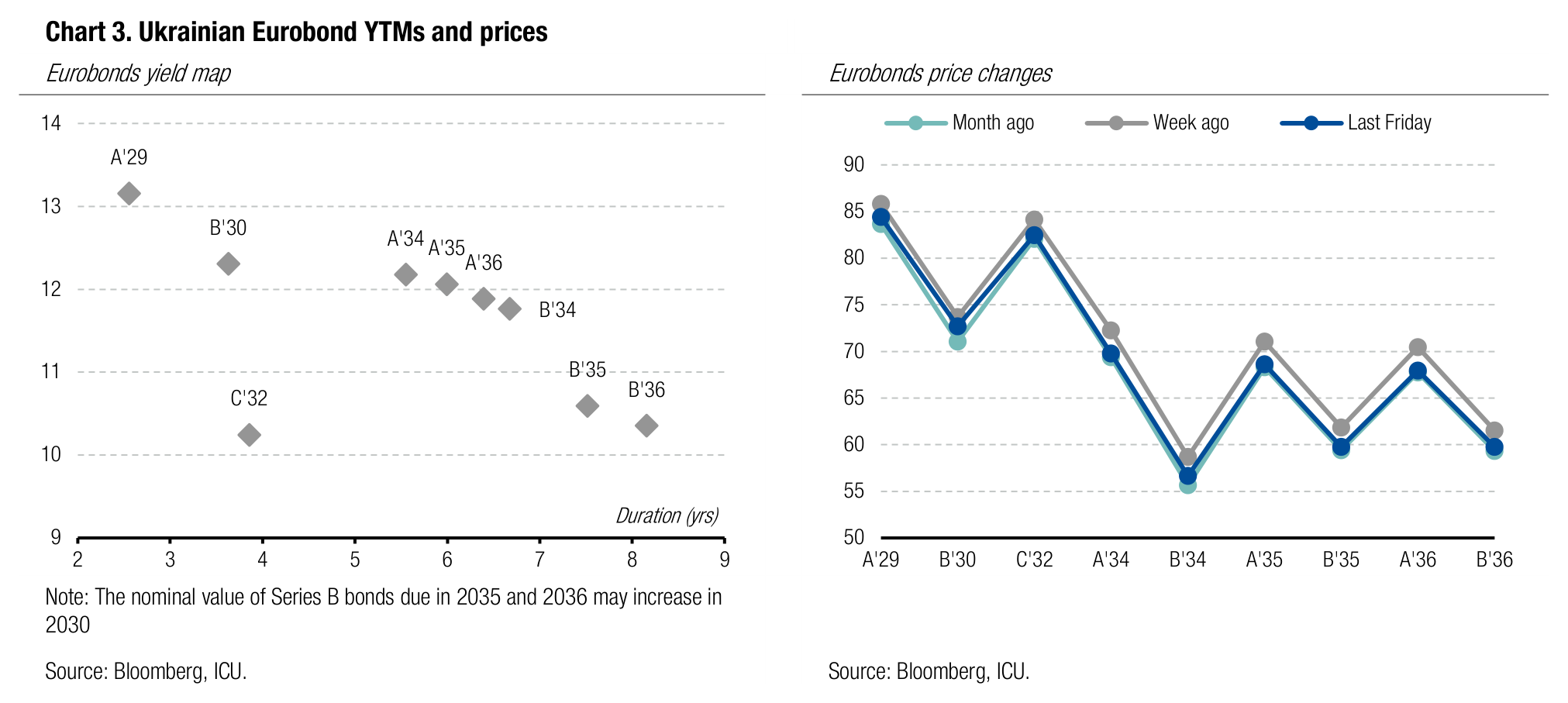
ICU view: A new wave of escalation in Iran was the central topic in the market last week, overshadowing approval of the first Ukraine program review by the IMF. Ukrainian Eurobond prices remain highly susceptible to both domestic and global factors with volatility far exceeding that of other developing countries' bonds. We expect Ukrainian bonds will remain under elevated pressure if there is no real de- escalation in the Middle East.
Foreign exchange market
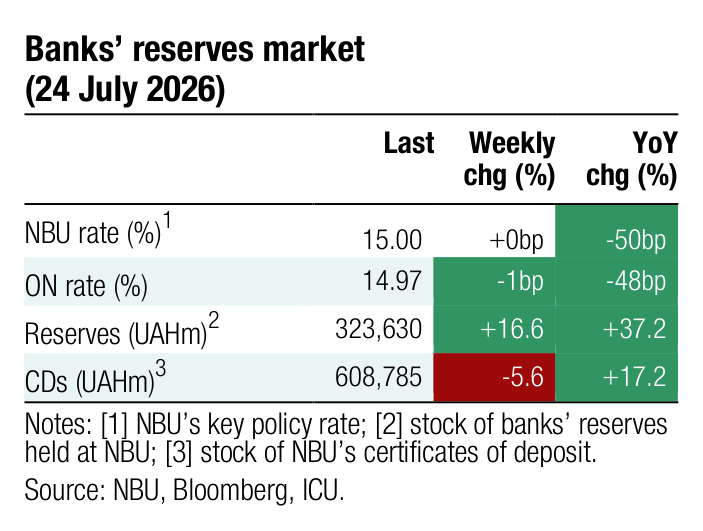
NBU narrows hryvnia fluctuation band
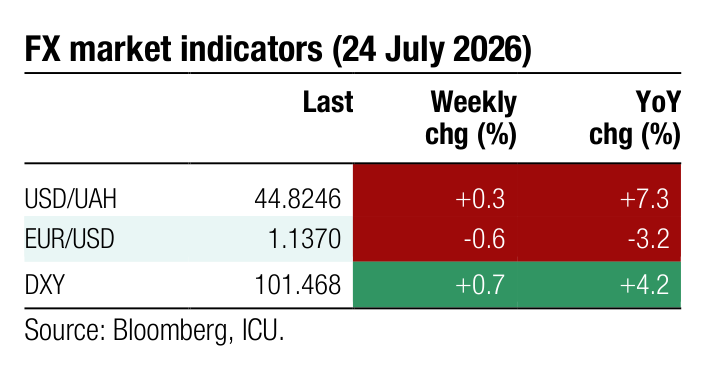
The National bank of Ukraine only marginally reduced interventions while trying to narrow the hryvnia fluctuation band.
The NBU sold over US$1bn last week, only 5% less WoW while trying to maintain the exchange rate within the range of UAH44.7-44.8/US$. The hryvnia weakened by 0.3% to UAH44.81/US$ last week.
The FX shortage in the market was down noticeably, mainly on healthier supply from legal entities. In the interbank FX market net hard currency purchases fell by 16% to US$564m, and in the retail segment by 29% to US$33m.
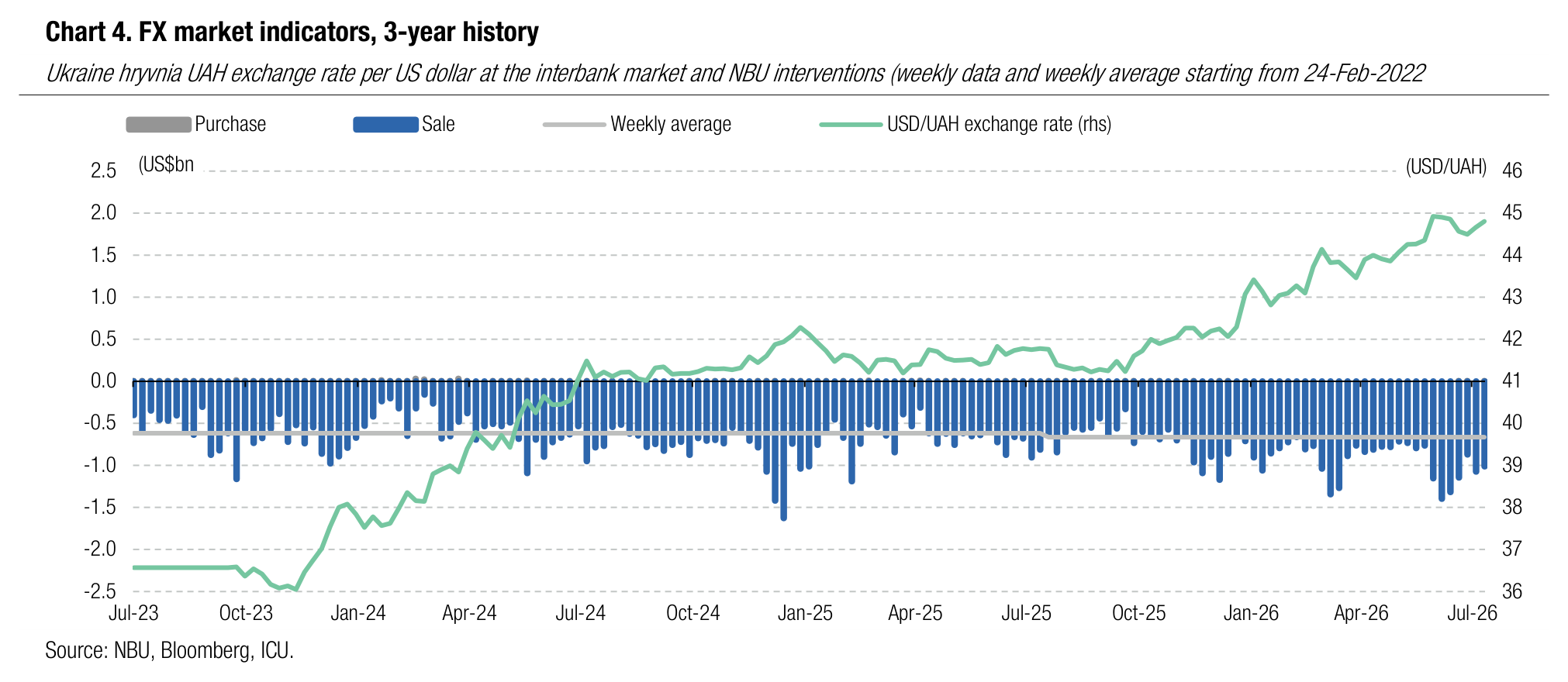
ICU view: Since the approval of the first review of the IMF program, the NBU is trying to narrow the fluctuation range of the hryvnia. This approach is costly as central bank interventions remain very high. Looking forward, we expect the coming weeks are going to be even more challenging due to the numerous damages to the seaport infrastructure and a likely subsequent (temporary) decline in exports and FX supply. Therefore, the NBU may be forced to increase interventions even further through summer-end. Yet, the inflows of international financial assistance should be sufficient to fully compensate for the NBU's FX interventions at least in 2H26.
Economics
IMF reveals broadly neutral macro forecast for Ukraine
The IMF board approved the first review of Ukraine’s 48-month EFF program, which unlocked the second loan tranche of US$690m. In its MEFP, the fund provided detailed outlook for Ukraine’s economy.
The IMF expects Ukraine’s economy will continue to grow at a modest pace of 1.0-1.6% this year following a 1.8% increase in 2025. Noteworthy, this projection was finalized well before russia restarted massive attacks on Ukraine’s sea port infrastructure, which apparently pose risks to this forecast. Inflation is seen at 10.5% at the end of 2026, a substantial increase from 7.5% that the IMF saw in February. The expected higher CPI is primarily explained by surging fuel prices due to the US-Iran war. The IMF sees the NBU key policy rate remaining flat at 15% into 2027. The 2026 fiscal deficit before grants is now seen at 21.1% of GDP (vs 19.3% in February) while the current account deficit before grants is projected at 22.8% of GDP (vs. February expectation of 19.9%). The fiscal gap and the shortfall of the current account are expected to be fully covered with foreign financial aid – the aid estimate was increased to US$54.8bn from US$51.4bn in February. The Ukraine Support Loan, the largest component of inflows, is treated as a grant. The IMF also improved its outlook for the hryvnia, and the fund now sees average 2026 exchange rate at UAH44.5/US$ vs UAH44.9/US$ in February.
ICU view: IMF macro projections remain broadly conservative; macro and financial stability are, expectedly, fully based on sizeable inflows of foreign financial aid. We maintain our even more conservative projection of 2026 GDP growth of 0.8%, but we are more optimistic about inflation and think the CPI will end the year in high single digits. Regarding the exchange rate, we think the NBU may aim to be close to IMF numbers implying the need for a moderate depreciation in 2H26. We maintain our end- 2026 exchange rate forecast of USH45.8/US$.