

Ukrainian bond market
MoF increases net borrowings in July; faces yield dilemma after NBU hike
The Ministry of Finance increased net borrowings in July and improved rollover vs. June. Now, the MoF must decide if yields on bonds should be adjusted following an increase in the NBU key policy rate.
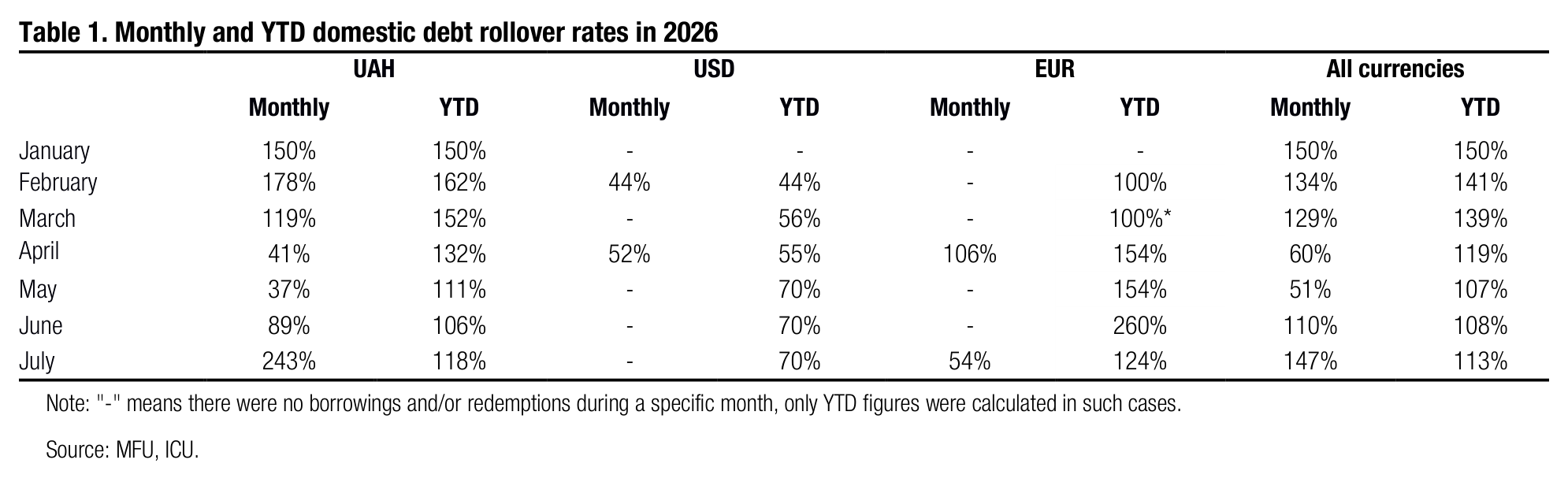
The total amount of borrowings in July – that includes the placement via an exchange auction – amounted to UAH54.8bn, slightly more than in June. At the same time, redemptions totalled UAH37.2bn, a fifth below June’s volume. Therefore, net borrowing in all currencies amounted to UAH17.6bn in July and to UAH35.3bn in 7m26.
In July, local debt rollover in all currencies was 147%, including 243% in hryvnia and 54% in euros. In 7m26, rollover stood at 113%, including 118% in hryvnia, 70% in US dollars, and 123.9% in euros.
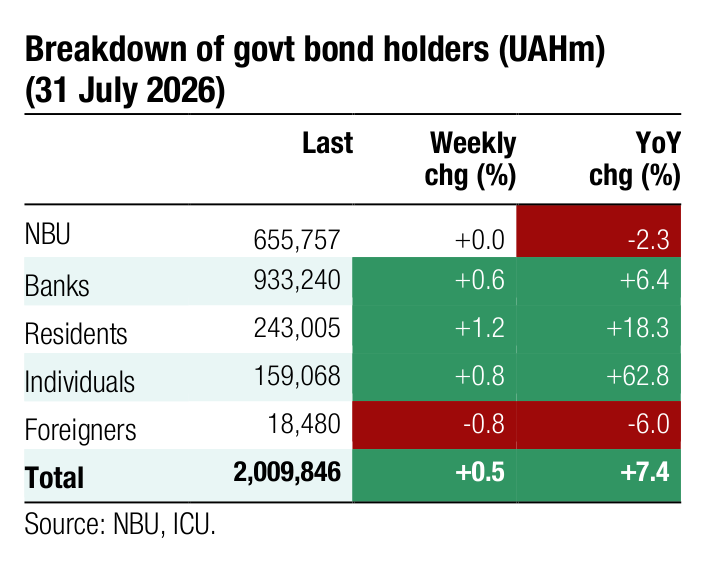
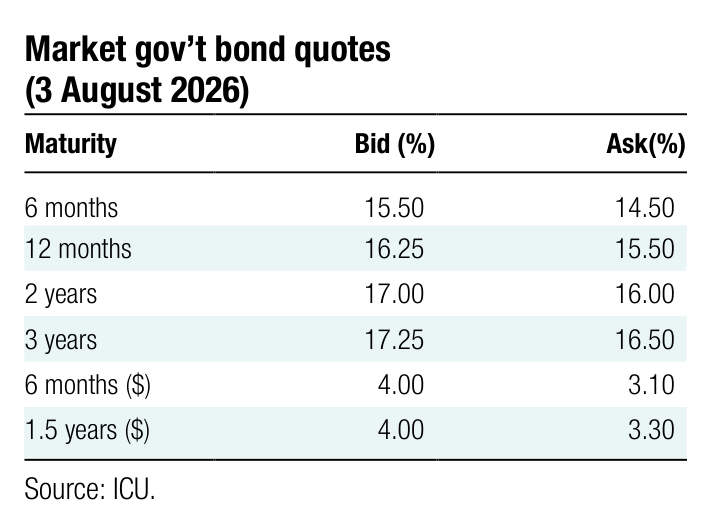
Last week, the key event that may have an impact on the local debt market was NBU’s decision to increase the key policy rate by 50bp to 15.5% (see comment below ). The MoF kept the yields in the primary market broadly unchanged since March – 15.15% on one-year bonds and 16.15% on three-year notes before adjusting them marginally to 16.0% in July. In the secondary market, yields were little changed in the range of 15.4%-17.0% since March too.
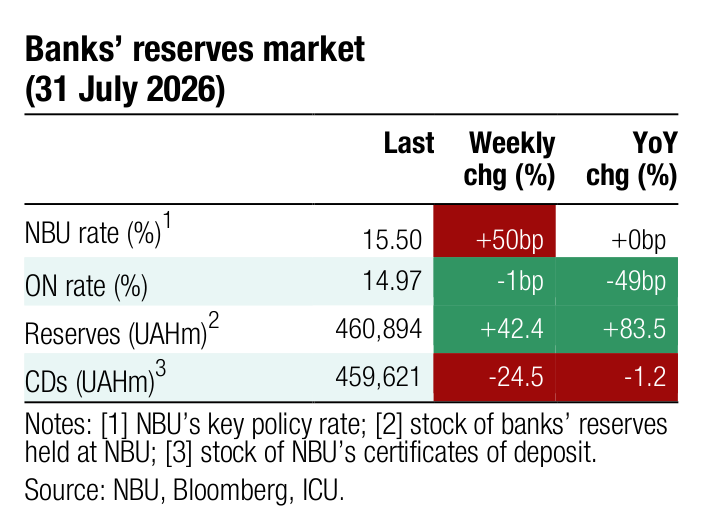
ICU view: In 7m26, the Ministry of Finance has met 71% of the current annual borrowing plan. Therefore, the MoF may temporarily reduce the pace of borrowings at least in August. Looking forward, the MoF may now be facing the dilemma as whether or not to adjust yields on hryvnia debt following the NBU 50bp hike and taking into account its guidance that another hike of 50bp may follow soon. We don’t expect the MoF will raise yields on paper with tenors of longer than two years. Yet, we don’t rule out an increase in rates on shorter papers. These issues remain in high demand from retail and corporate clients as their yields are significantly more attractive than yields on deposits – demand will remain robustly strong even with current yields. However, if MoF wants to see higher demand for shorter paper from banks, it will have to react. The latest placements came at a yield that is below the post-hike rate of the NBU certificates of deposits (15.15% vs 15.5%). Given NBU guidance that a decrease in key policy rate is unlikely at least until 2Q27, much more liquid overnight CDs offer a better yield-liquidity profile than short-term government bonds.
Foreign exchange market
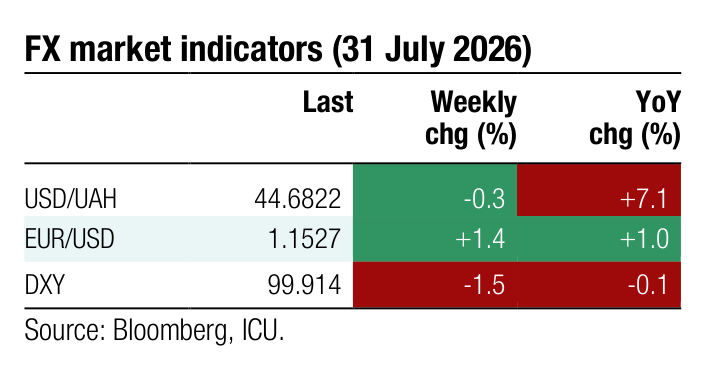
NBU defends hryvnia decisively; promises new FX liberalisation measures
The FX market deficit remains high, with NBU weekly interventions exceeding US$1bn to keep the hryvnia rate below UAH45/US$.
Last week, the hard currency deficit widened to US$652m over four business days. The NBU sold over US$1.1bn (up 12% WoW) to cover excessive market demand and keep the hryvnia below UAH45/US$, a level the interbank FX market was about to cross on Wednesday.
With large interventions, the NBU allowed the official exchange rate to reach only UAH44.93/US$ and, by the end of the week, to return to UAH44.64/US$. July ended with the hryvnia strengthening by 0.3% MoM, but weakening by 5.4% YTD.
During a monetary policy decision press conference, the governor said the NBU is preparing a new set of FX market liberalisation measures. No further details were provided.
Additionally, during the press-conference, the NBU said it considers weekly interventions close to US$1bn acceptable given the decline in FX earnings following the damage to sea ports logistics. The NBU also considerably increased its projection of gross reserves and now see them at US$69.7bn at end-2026 and at US$73.7bn at end-2027.
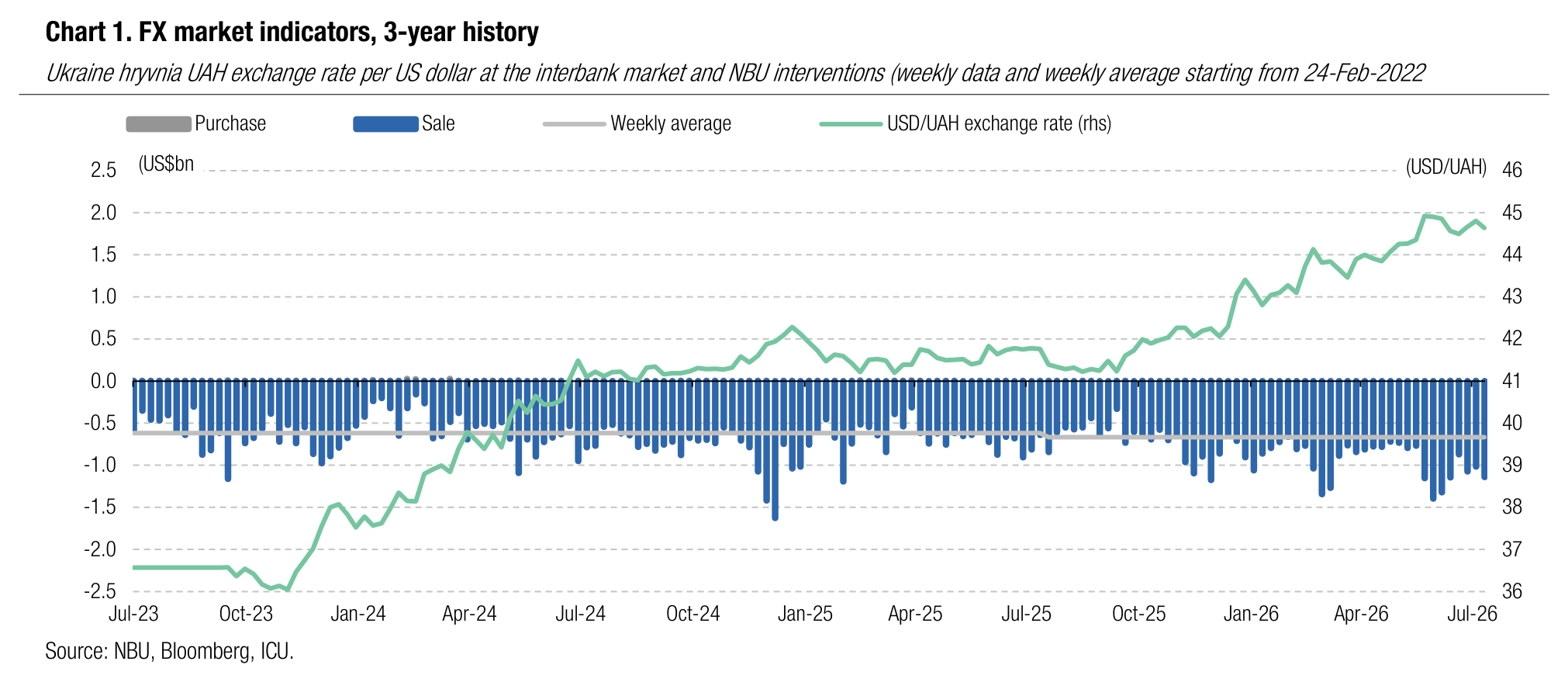
ICU view: Last week, the NBU clearly showed it is currently prepared to defend the hryvnia and not let the rate slip above UAH45/US$. We remain of the view that the NBU will allow only moderate hryvnia depreciation from the current level, and we see end- 2026 rate at UAH45.8/US$. The NBU’s new forecast of gross reserves reinforces our view that the central bank will have enough firepower to defend the rate, at least in the next 18-24 months.
Economics
C/A boosted by budgetary grants
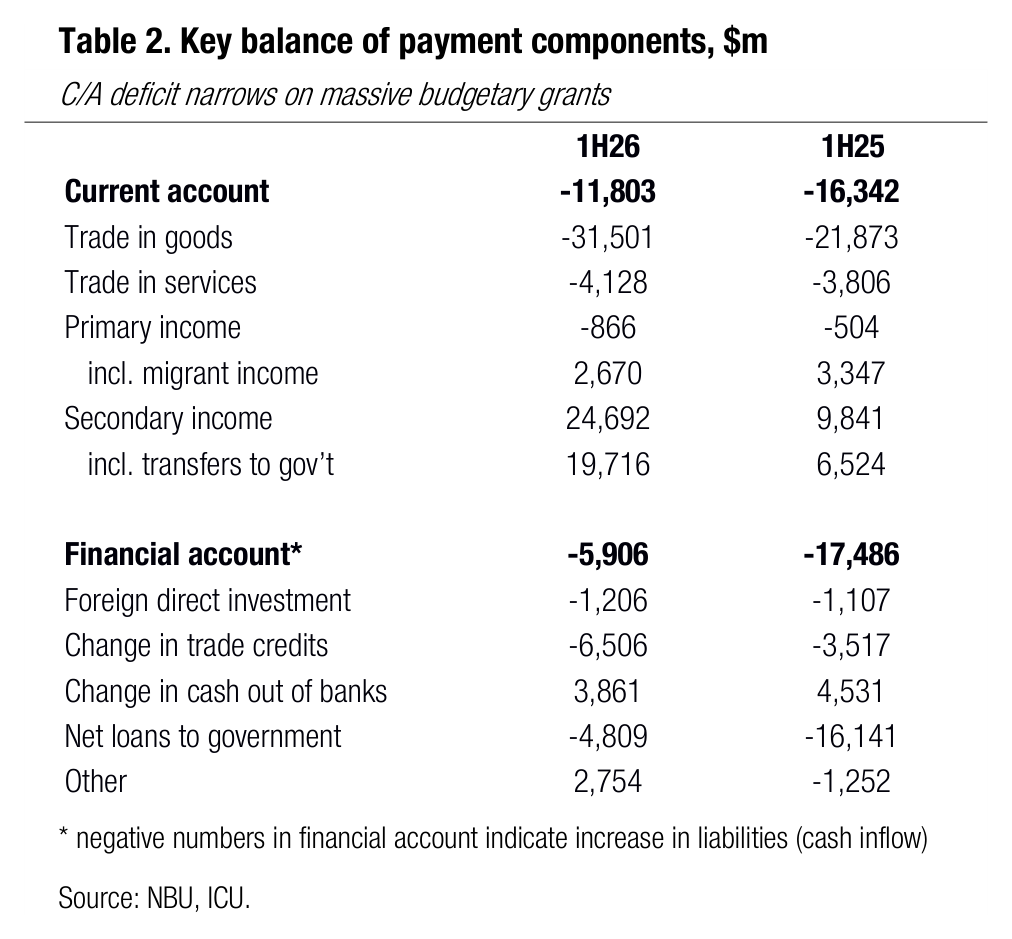
Ukraine’s current account turned to a surplus of US$6.3bn in June on massive inflows of foreign financial aid treated as budgetary grants. The C/A balance was still negative at US$11.8bn in 1H26.
Foreign trade in goods remained the key drag with June monthly deficit remaining close to all-time highs and 1H26 gap at US$31.6bn, which implies a 12-month trailing deficit at 27% of 2026 GDP. Import of goods was up 26% YoY in 1H26 while export increased only 5%. The balance of trade in services was little changed YoY, as was the balance of primary income. Yet, secondary income spiked to US$12.8bn in June on massive inflows of foreign financial aid that is classified as grants.
The balance of the financial account was marginally negative in June, but 1H26 ended up with a surplus of US$5.9bn driven by a reduction in foreign trade credits and official borrowings. An upsurge in foreign aid in June brought the combined balance of current and financial accounts close to zero, but that was substantially negative in 1H26 denting the NBU reserves that declined 11% in 1H26 to US$51.3bn.
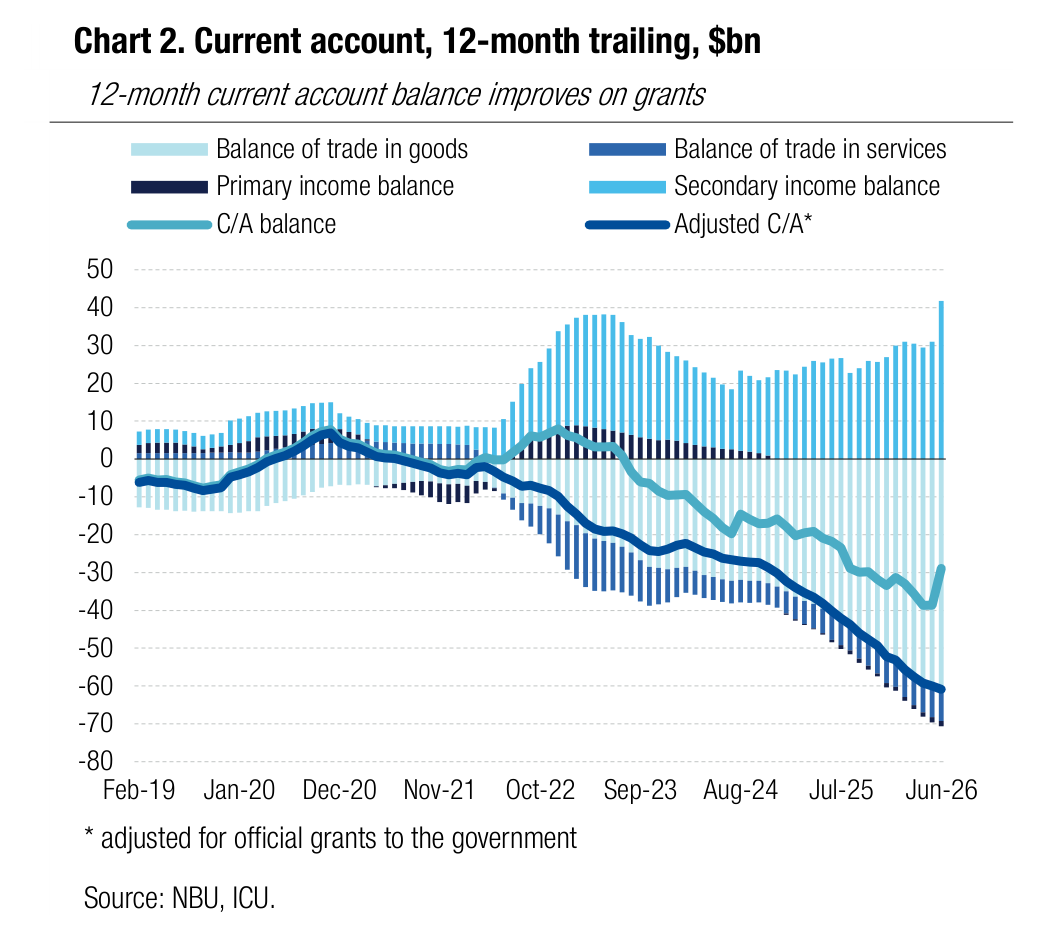
ICU view: We expect the country’s external accounts will be in hefty surplus in 2H on significant inflows of foreign financial aid. That will ensure that the NBU will have sufficient resources to maintain significant interventions in the FX market while continuing to build up reserves.
NBU resumes tightening
The regulator raised the key policy rate by 50 bps to 15.5%, citing sustained fundamental price pressures and a materially worse inflation outlook.
The move ends the on-hold stance maintained since March. Although headline CPI slowed to 7.2% YoY in June on fresh food supply, core inflation accelerated to 8.1% YoY, above the April forecast trajectory. The regulator now expects headline CPI at 10.9% and core at 9.2% by end-2026, driven by rising business costs, fiscal stimulus, and second-round effects from earlier fuel price increases and hryvnia depreciation. Disinflation is projected to resume in 2027 (6.9%), with the 5% target reached only at end-2028. The 2026 real GDP forecast was revised upward to 1.8%, reflecting a larger fiscal impulse and the shift toward domestic financing of arms production under the defence component of the USL programme. International reserves are seen approaching US$70bn by year-end, supported by around USD54bn of direct budget support. The NBU flagged an expanding intermediary role in the FX market amid higher structural import demand, while confirming the managed flexibility regime. Key risks include intensified strikes on port infrastructure (an estimated US$2.5bn of export proceeds will be delayed from 2H26 to 1H27), wage pressures, and renewed oil price volatility. Alongside the rate decision, the NBU announced an auction- based access mechanism for 3-month CDs from August and a forthcoming FX liberalization package.
ICU view: The updated NBU macro forecast implies another 50bp hike in September. By the time of the next review, CPI prints for July and August will be available. We see downside risk to this trajectory, as the regulator may abstain from a further hike should external conditions improve.