

Ukrainian bond market
MoF alters approach for reserve bond exchange
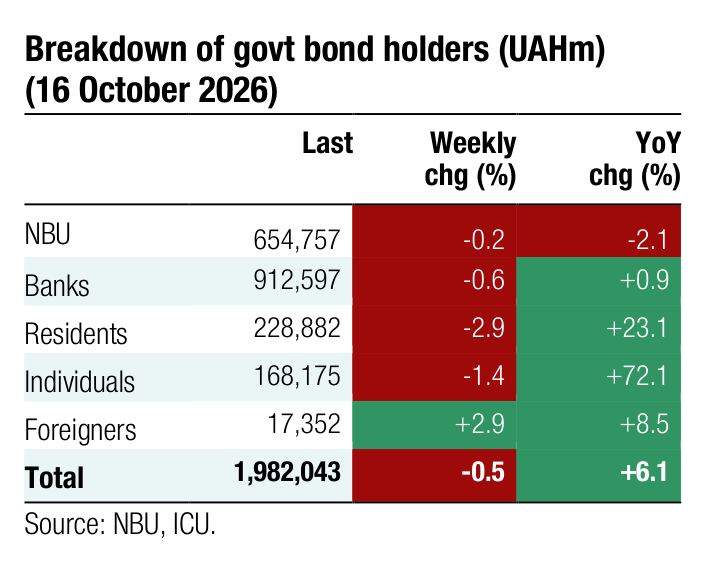
The Ministry of Finance’s initial plans to exchange reserve bonds via a single auction were altered, and the MoF opted for two separate auctions involving different reserve bonds.
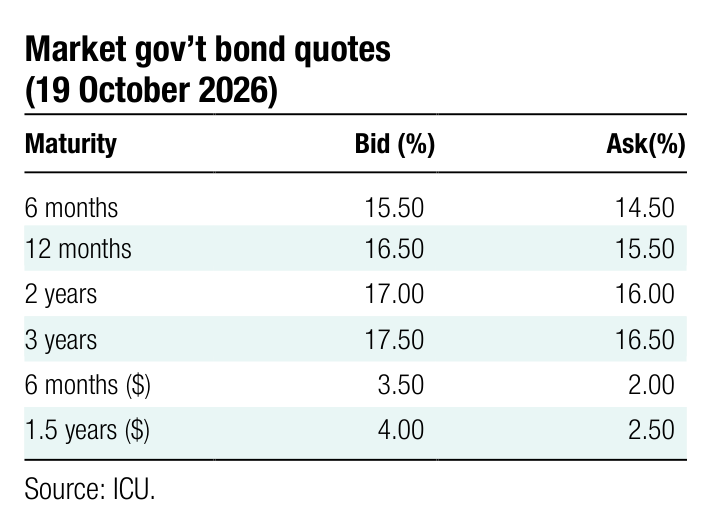
The government planned to exchange reserve bonds maturing in November (the last one this year) for a new bond that had been offered for the first time at the auction in early October. However, for reasons that were not undisclosed, these plans were altered. Last week, the ministry conducted the first exchange, swapping the November-maturing securities for a reserve bond maturing in May 2029; UAH5bn worth of new paper was issued at a yield just above 12%. The ministry announced a second exchange auction this week, looking to swap the paper for a new one due in April 2029 (previously offered in May and June 2025). The offering is expected to reach UAH7bn.
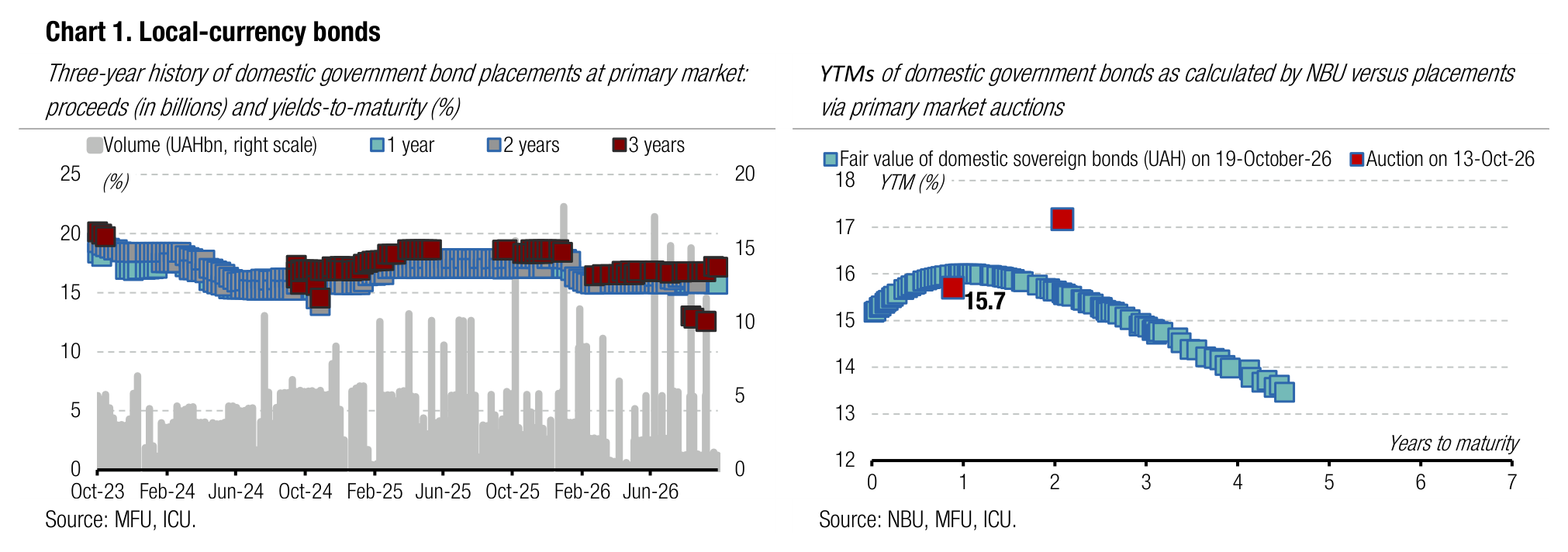
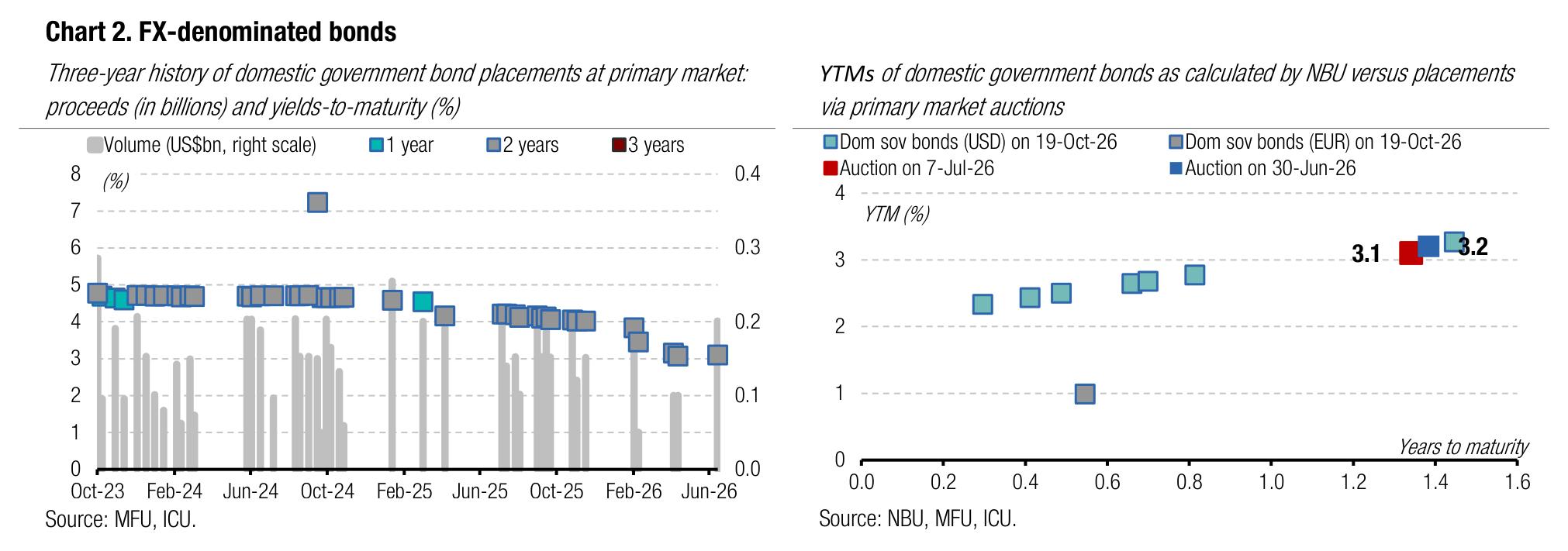
ICU view: It remains unclear why the bond issue—which, by all signals, was supposed to be designated as a new reserve instrument—was eventually rejected by the NBU for inclusion in the list of bonds that can be used to cover mandatory reserves. Nevertheless, the Ministry of Finance managed to exchange a part of the issue maturing in November (the last reserve bond maturing this year), thereby reducing the liquidity needs for domestic debt redemptions in November. Looking forward, we estimate the Ministry of Finance will need to borrow approximately UAH3bn per week through end-2026 to meet its full-year borrowing plan. This assumes that the budget financing plan relying on domestic sources remains unchanged.
Investors concerned by the US actions
Last week, yields on Ukrainian Eurobonds rose significantly on intensifying negative rhetoric about Ukraine from US President Trump.
In September, the President Trump’s rhetoric concerning Ukraine began to sharpen once again when he started putting blame for diesel fuel shortages and rising prices on Ukraine, linking them to strikes on russian oil refineries. Furthermore, it became evident last week that no negotiations or agreements about a ceasefire—even a partial one—are materializing, despite Ukraine having paused its strikes on russian energy infrastructure for several days. On Friday, Trump announced that he would not invoke the Lindsey Graham Act against russia.
Investor concerns grew steadily under this backdrop. While yields stood at 11–13% in early September, by the end of the month, they had risen to 14–17% for Series A bonds and 12– 15% for Series B bonds. In October, the yields surged further: last week, YTMs reached 15– 21% for Series A and 13–18% for Series B. During this period, yields for Series C increased from nearly 11% to over 12%.
Alongside rising YTMs, the inversion of the yield curve became more pronounced: the spread between Series A bonds maturing in 2029 and 2036 widened from 50–90bp in early September to 660bp last week. Similarly, spreads for Series B—specifically for bonds maturing in 2030 and 2034—widened from 80bp in early September to 360bp last week.
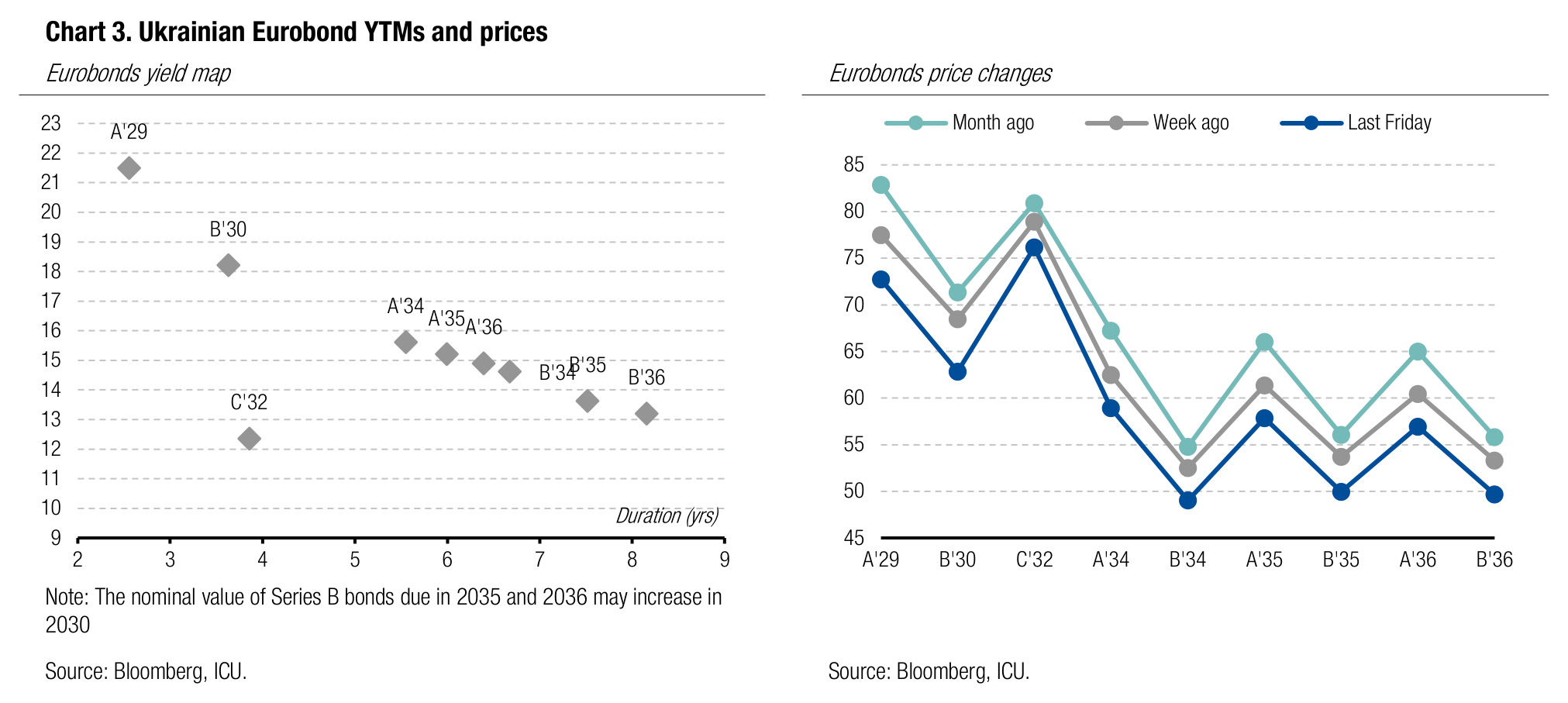
ICU view: Investor anxiety rose significantly. In the absence of negotiations and US military support, the safety situation in Ukraine could deteriorate—even with unconditional and substantial military support from the EU. Trump's rhetoric increased the risk of a prolonged pause in the negotiation process, which will, in turn, weigh on investor sentiment. Furthermore, the failure to apply the Lindsey Graham Act to russia is likely to exacerbate investor concerns. Therefore, yields on the shortest- term bonds may continue to rise this week, further widening spreads over longer-term bonds.
Foreign exchange market
NBU tests new levels for the hryvnia
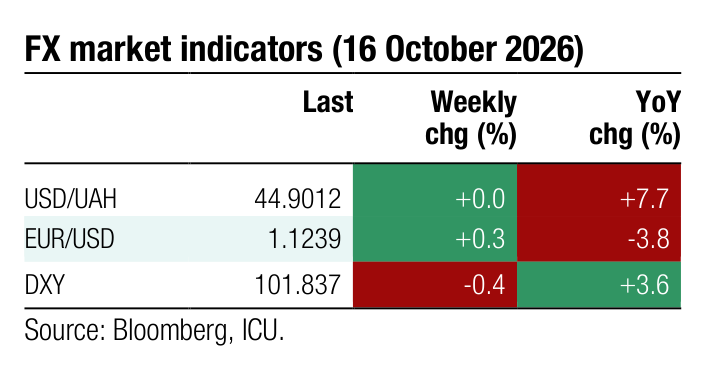
Last week, the National Bank of Ukraine once again allowed the official hryvnia exchange rate to cross the UAH45/US$ mark, though by the end of the week, it had pulled the rate back slightly.
The overall FX deficit remained roughly unchanged WoW, and NBU interventions stayed above US$1.2bn. Consequently, there were no specific drivers for a visible move in the USD/UAH exchange rate. Nevertheless, on Monday and Tuesday, the NBU allowed the market to breach the UAH45/US$ level, setting the official exchange rate for Wednesday at an all-time high of 45.08 UAH/$. Overall, the hryvnia weakened by 5.9% YTD.
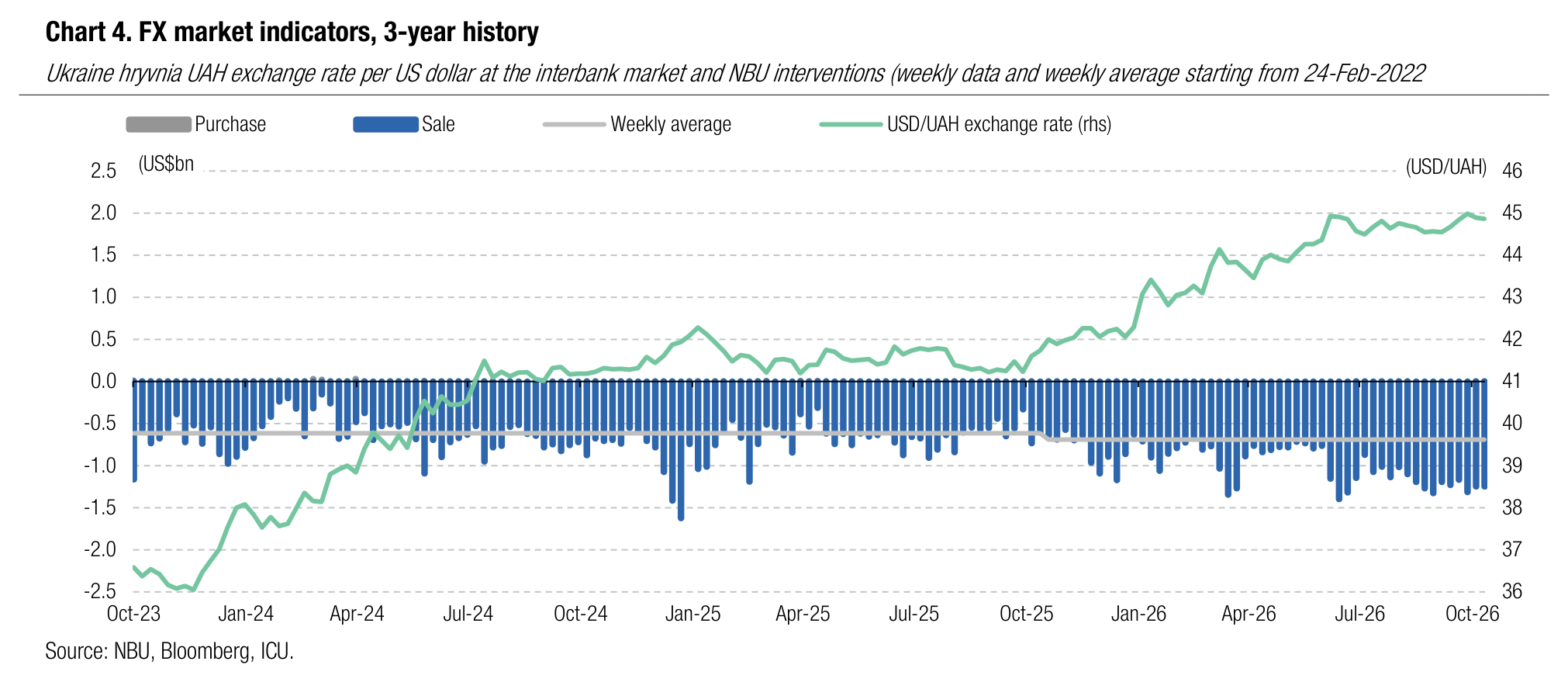
ICU view: The NBU is not rushing to weaken the hryvnia. For now, it allows the US dollar rate to cross the UAH45/US$ threshold only occasionally, promptly bringing it back below that level thereafter. We expect the NBU to continue increasing exchange rate volatility, gradually moving toward a level of UAH45.8/US$ by the end of this year. The structural deficit remains substantial due to significant spending on domestically produced weaponry, which requires manufacturers to import various components. Furthermore, demand for foreign currency is rising due to russian attacks on energy infrastructure. Therefore, the NBU will likely need to maintain its interventions at a similar—or potentially even higher—level.
Economics
The fog thickens
The Ukrainian economy is going through the most challenging period since 2022, as russia’s terrorist attacks on industrial facilities as well as national storage and transport infrastructure continue unabated. Key points of our new macro review , published last week, are given below.
The outright loss of assets by many businesses is amplified by an unprecedented uncertainty and suspension of critical sea export routes. As much of the damage will be irreparable during the war, the economy is set to contract in 4Q26 and further in 2027. Yet, we expect only a contained decline as the structure of the economy has shifted heavily towards services and the defense sector over the past years.
Economic contraction is being accompanied by a pick up in inflation, which has been in double digits since September. We now expect the CPI peak to be close to 12% during the winter, and the yearly tally will only return to single-digit territory in 3Q27. The inflation surprise can be mainly put down to cost pressures due to more expensive logistics and higher fuel prices.
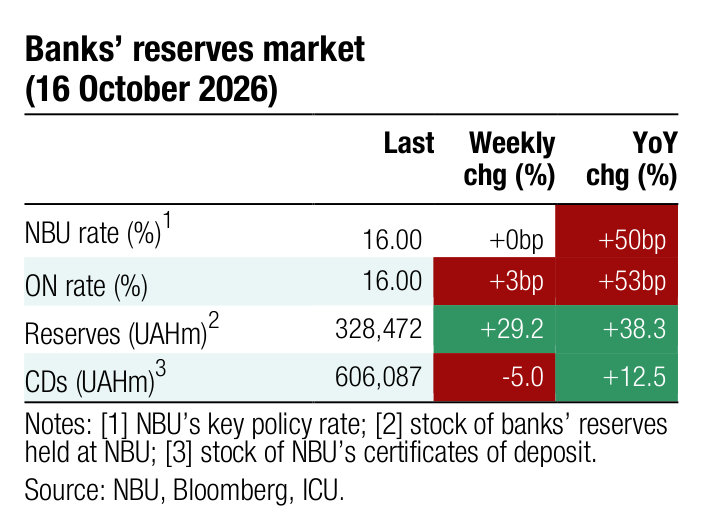
With new risks crystalizing, the NBU may choose to deliver another 50bp key policy rate hike to 16.5% and will likely keep the rate at this level through end-1H27. The NBU is facing growing challenges in making transmission work as commercial rates have stayed unresponsive to NBU’s move over the past several months.
The deficit of external accounts (net of foreign aid) continues to grow. Export shrank as sea transportation routes are effectively closed while import is expanding on purchases of foreign weapons and their components, all being funded with a defense component of USL. Concessional funding, although much delayed, should remain sufficient for patching the external gap at least until end-2027.
This implies the NBU will remain in a strong position to keep the FX market under its full control. We see only moderate hryvnia depreciation in 4Q with the rate reaching UAH45.8/$ at end-2026 and UAH49.2/$ at end-2027.
On the fiscal front, we see 4Q government liquidity problems as temporary, but 2027 presents a real challenge. The government is yet to secure over US$25bn in additional funding needed for the next year. Like in previous reports, we assume no major change in the security risks in the medium-term – no peace deal and no major territory gains by the enemy.