

Ukrainian bond market
Households become main lender to government
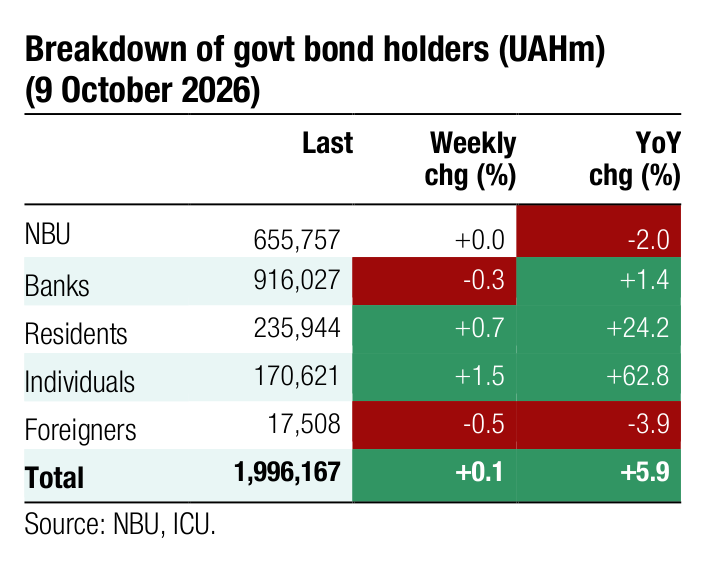
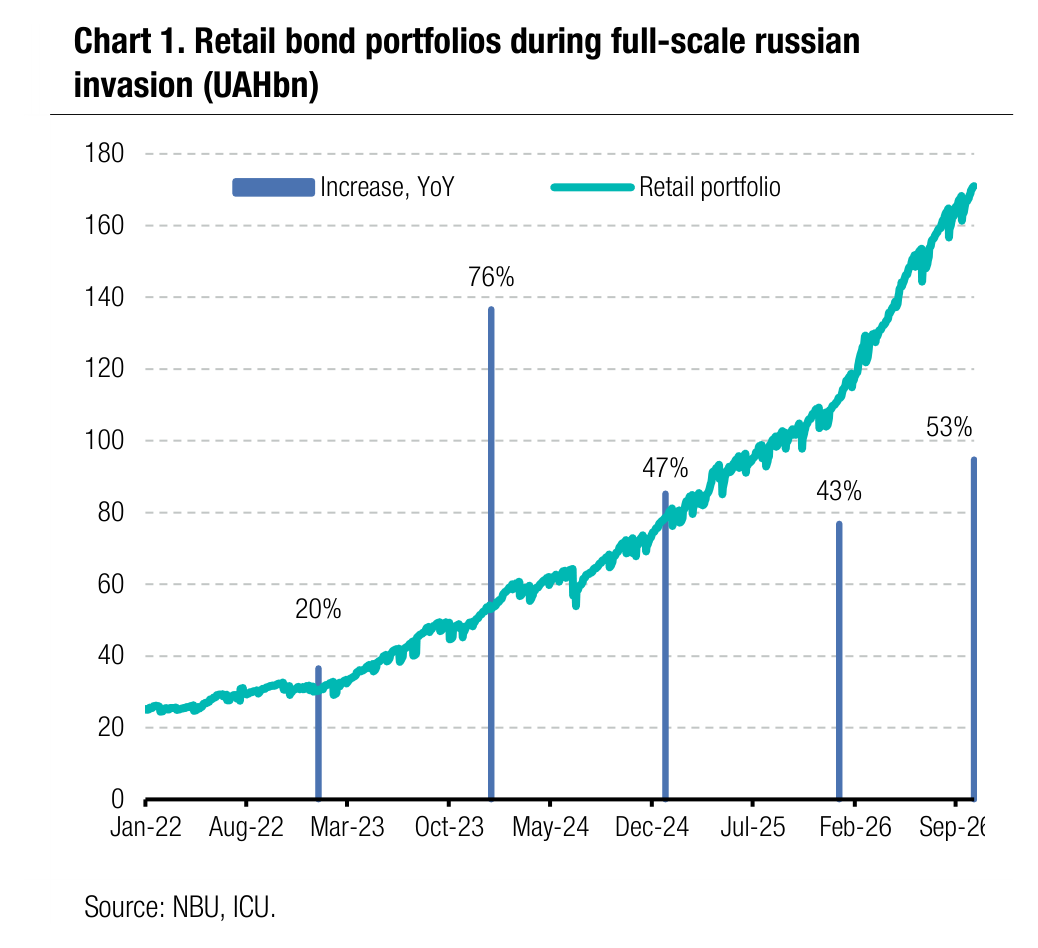
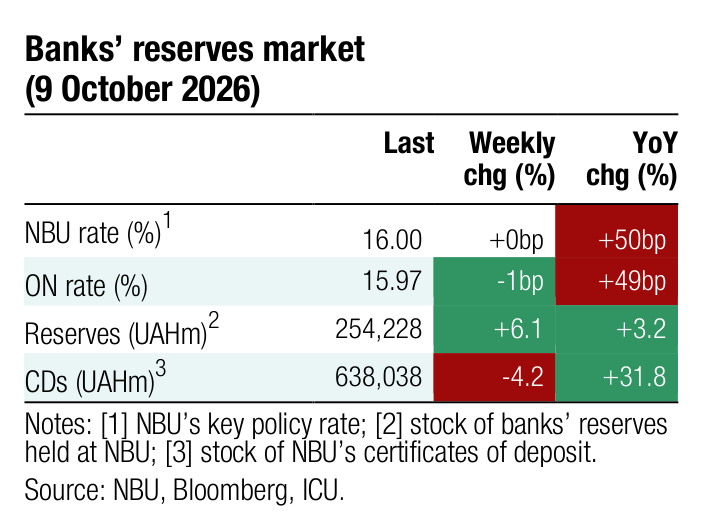
Retail investors continue to expand their portfolios of local debt and have jointly become the most significant lender to the government domestically YTD. Household investments in domestic government bonds were up by more than 50% YTD.
In September, the portfolio of retail investors grew by nearly 3%, taking the YTD increase to almost 53%. The current pace of portfolio growth exceeds that in the two previous years despite a much higher base. The share of UAH-denominated bonds in retail portfolios remains consistently above 61%.
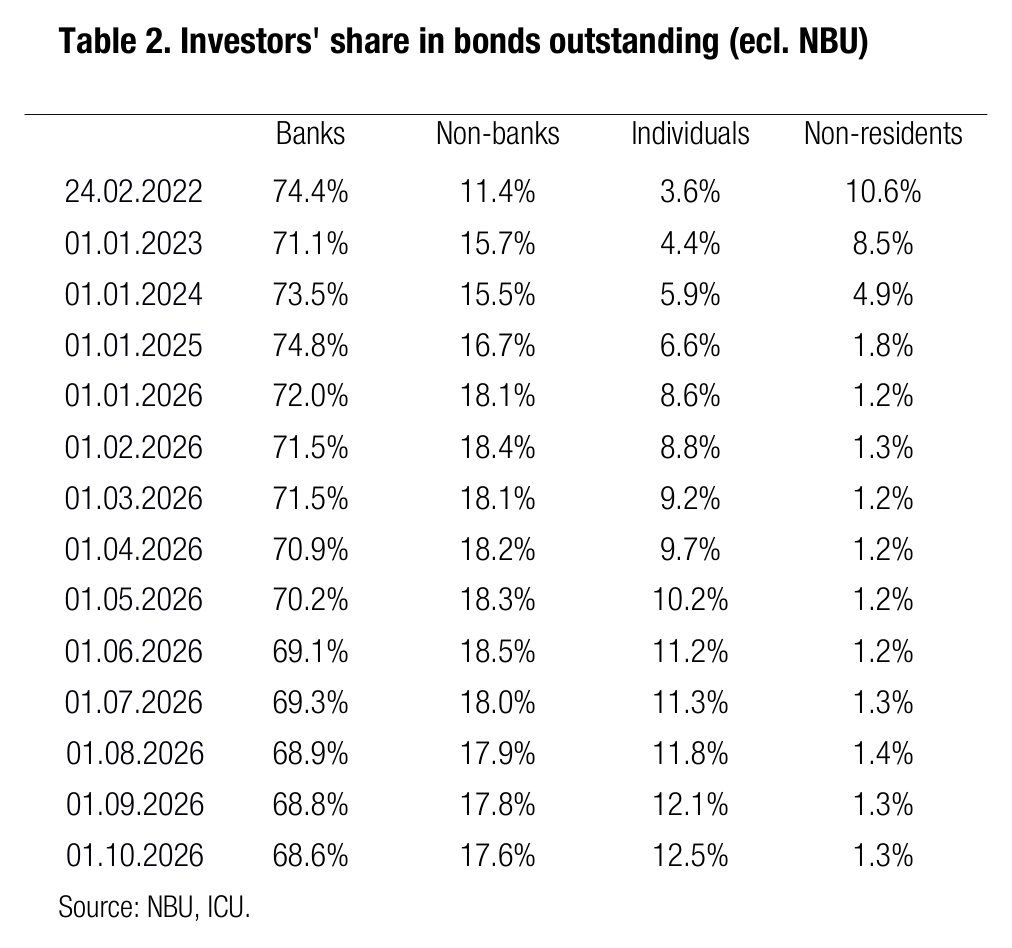
The total retail portfolio currently exceeds UAH171bn (US$3.8bn). Population share in the total stock of local debt (excluding bonds held by the NBU) reached 12.5% (+4pp YTD). Meanwhile, banks’ share was down by 3.4pp, and that of legal entities slid by 0.6pp.
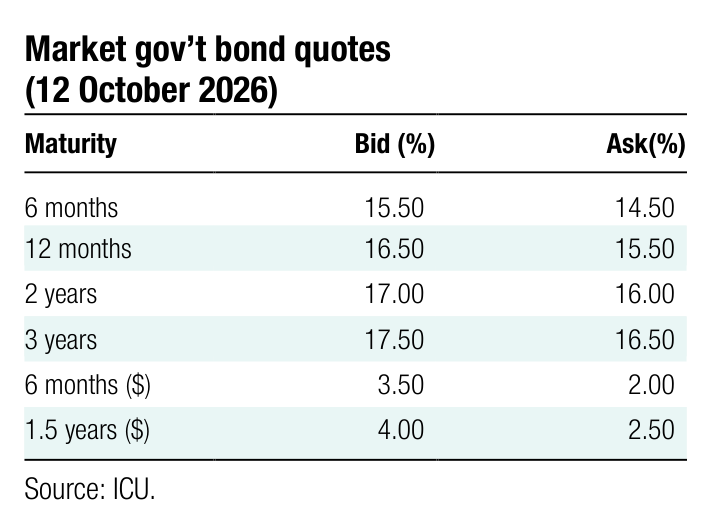
ICU view: The terms of retail bank deposits remain much less attractive compared with government bonds, both in terms of yields and the taxation regime. Easier market access, driven by the rollout of mobile apps, is further enhancing public interest in government bonds. Retail investors continue to prefer UAH-denominated bonds, although their share stabilised at 60–62% over the past few months. We expect the MoF to continue ignoring the NBU key policy rate hike to 16% and keep yields on government bonds broadly unchanged (probably with minor exceptions, like the one seen last week – see our auction review ). MoF will only be forced to raise yields at the primary auction if the government’s review of the 2026 state budget increases reliance on the domestic market for deficit financing; this remains a low probability even in our view.
Foreign exchange market
NBU interventions remain near peak
The National Bank reduced its interventions marginally, even though the foreign-currency deficit narrowed last week.
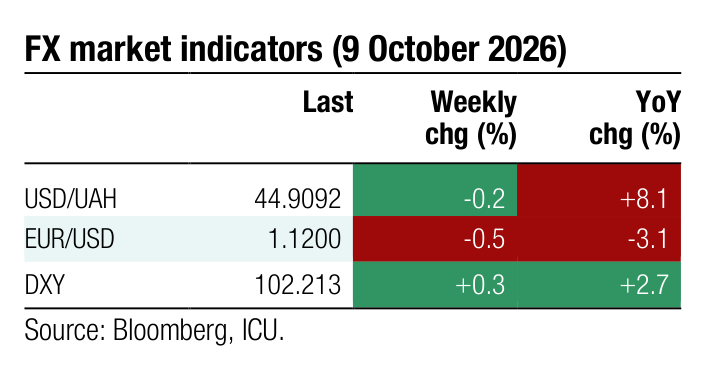
The total hard-currency shortage shrank one-third last week to US$0.7bn and was back to typical September levels. Meanwhile, the NBU cut interventions by just 5%, keeping the weekly total above US$1.2bn.
The NBU kept the hryvnia nearly unchanged WoW even though the market got nervous on Monday when the official exchange rate exceeded UAH45/US$ for the first time, albeit for just one day. Overall, the hryvnia weakened by 6% vs USD YTD.
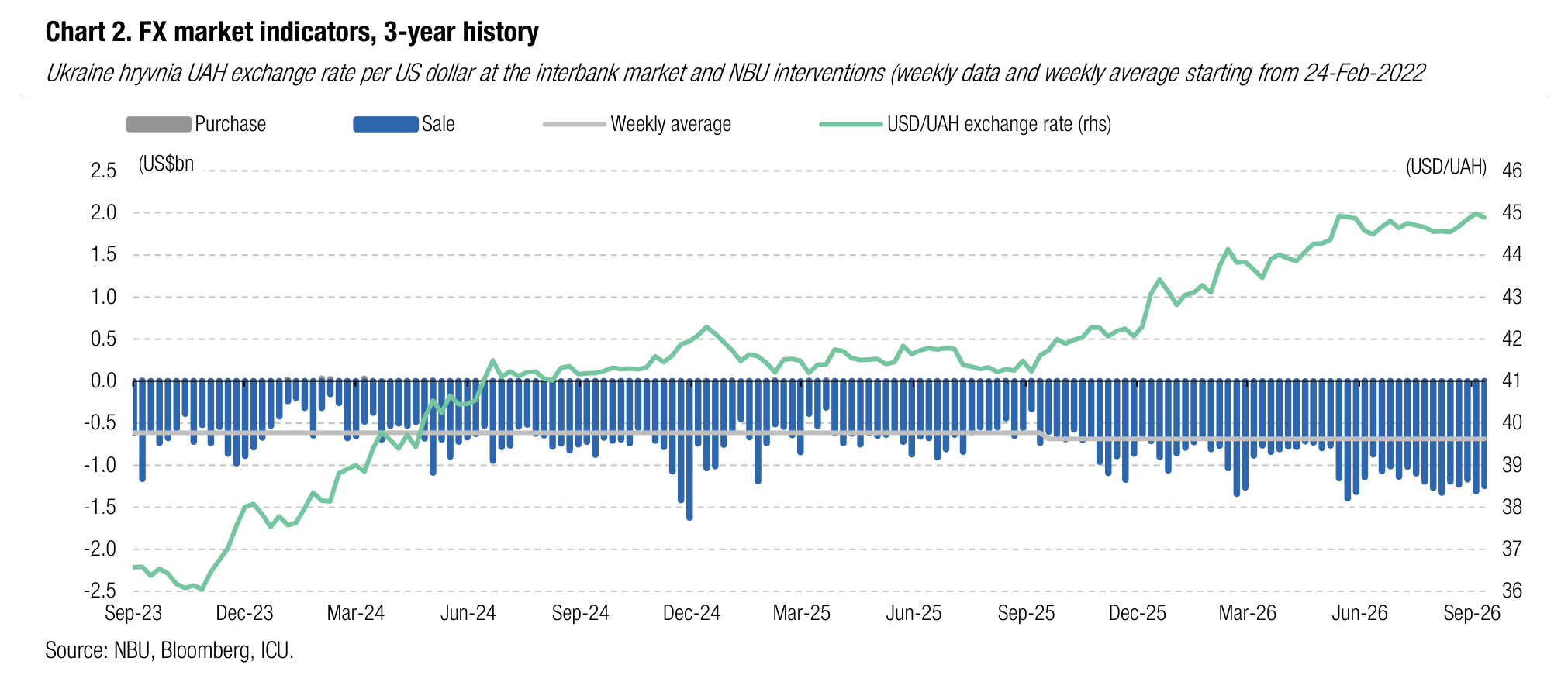
ICU view: NBU interventions remain elevated as banks replenish their foreign currency accounts following client purchases in late September and early October. The client- driven deficit narrowed noticeably last week. Yet, the structural deficit remains substantial, and the NBU will need to maintain a high level of interventions due to elevated imports of components for weapon and ammunition production. The demand for foreign currency may also see a temporary rise due to a new wave of russian attacks on energy infrastructure, as repairs will require additional import of equipment. The NBU remains determined to prevent substantial weakening of the hryvnia. Expectations are that the NBU will allow the US dollar to cross the UAH45/US$ mark occasionally in the coming weeks, while gradually moving toward UAH45.8/US$ by year-end.
Economics
NBU reserves down 3% in September
Gross international reserves of the NBU declined 3.2% in September (-17.8% YTD) to US$47.1bn on insufficient inflows of foreign aid. Reserves were equivalent to 4.0 months of the future imports by the NBU estimates.
NBU’s FX sale interventions hit a historical high in September at $5.4bn due to surging deficit of external trade. The inflows of foreign financial aid for state budget support were insignificant last month at below $0.9bn. Yet, a sizeable tranche of USL defense component of $3.8bn helped replenish the reserves partly as the government converted the funds received to pay to weapon and ammunition producers. Ukraine also repaid $0.4bn on official external debts.
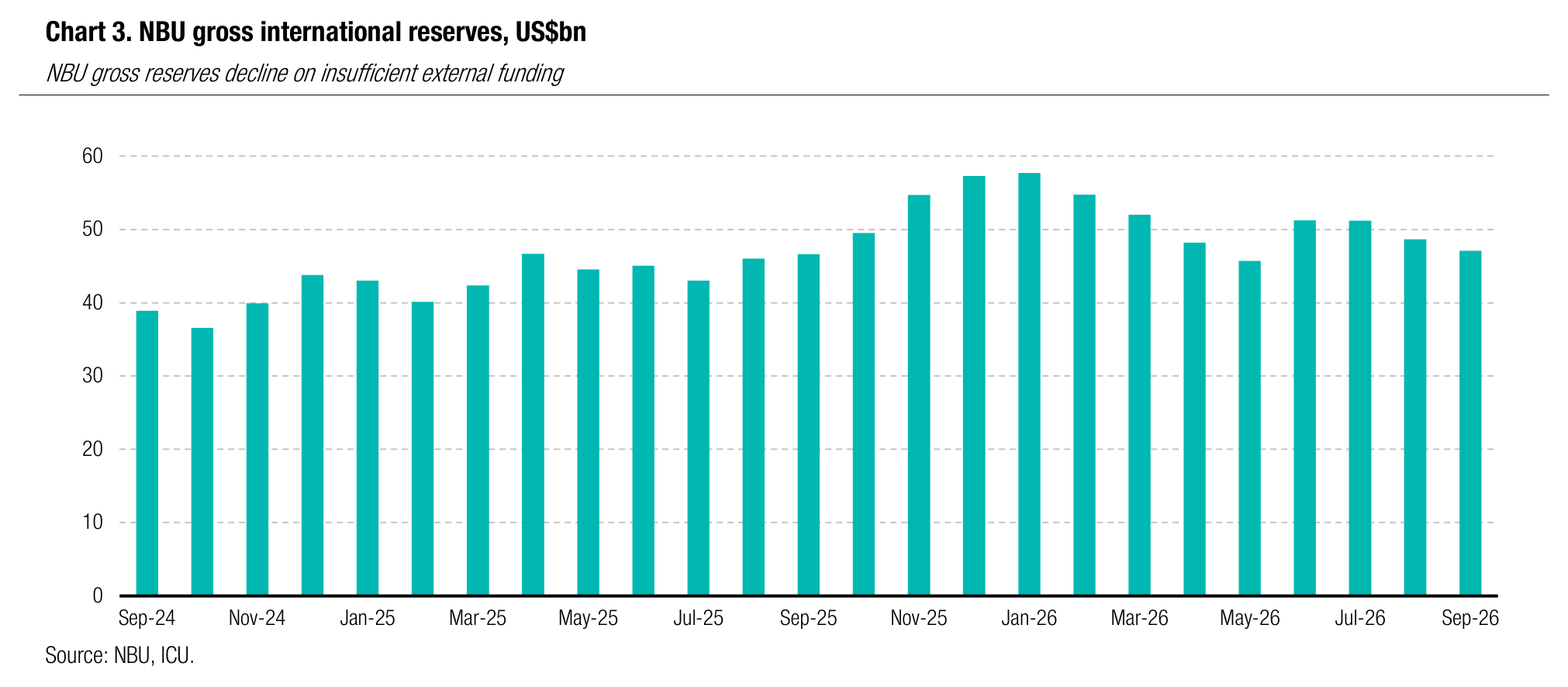
ICU view: NBU reserves remain volatile and highly dependent on the inflows of foreign financial aid. External funding remains behind schedule as Ukraine is still to implement some of the required economic reforms. Yet, we expect progress will gain pace in the coming weeks, and we see good chances of Ukraine receiving at least $22bn in budget support in 4Q26. Those receipts, combined with a defense component of USL, should bring NBU reserves up close to $60bn by the end of 2026.
Inflation back to double-digits
Annual CPI surged to 10.0% in September from 8.1% in August and the acceleration was broad-based. Core inflation was up to 8.8% YoY from 8.1% in August.
Monthly inflation stood at 2.1% last month, the highest September reading since 2015, when Ukraine experienced the previous major crisis and period of rapid hryvnia depreciation. Much of monthly inflation was driven by typical seasonal revision of prices, yet this year, the magnitude was much more visible. Prices for education services were up 17.4% MoM and accelerated to 19.6% in yearly terms (vs. 14.6% in August), prices for clothes and footwear jumped 8.5% MoM narrowing yearly decline to 4.7% (vs. 4.9% in September), and fuel and transportation prices were up by 2.7% MoM (26.9% YoY vs 23.8% in August). The largest disappointment was the prices for food that accelerated to 8.9% YoY from 5.9% a month before despite relatively strong harvest of gains, fruits, and vegetables.
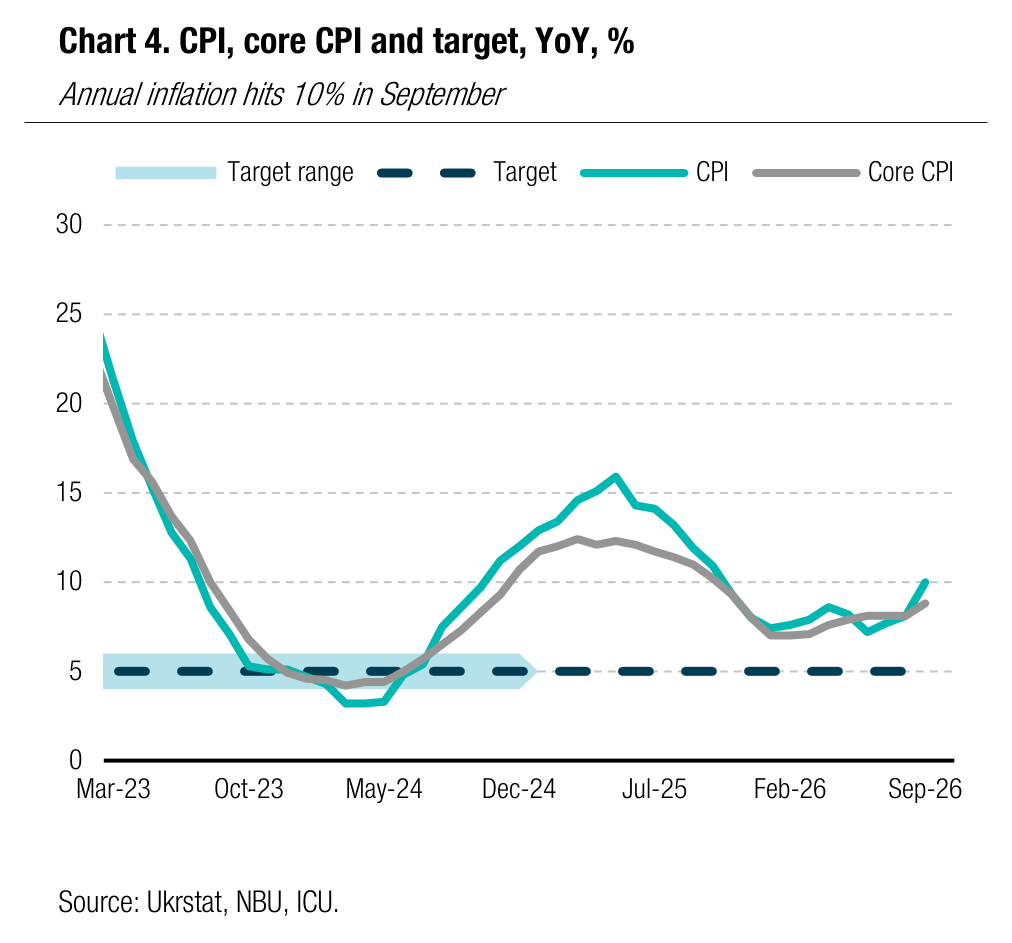
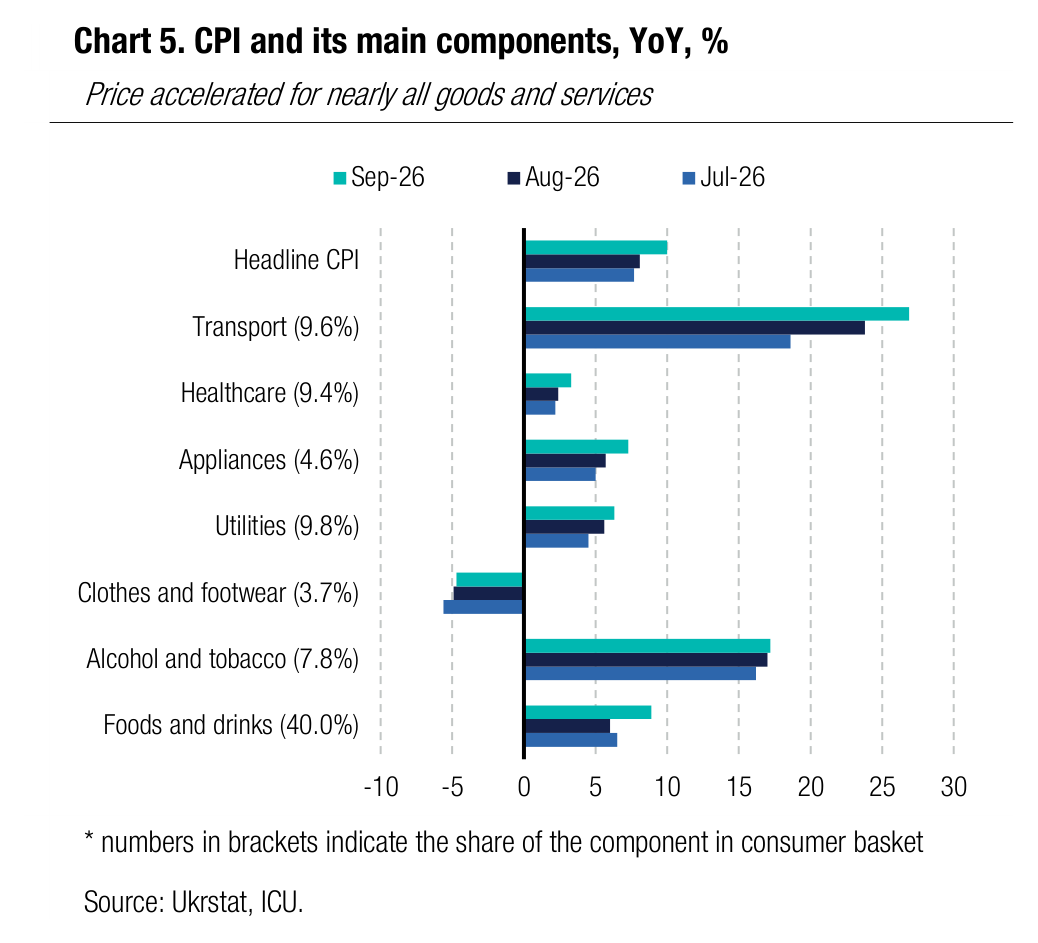
ICU view: September inflation was much higher than we and the market expected, thus underscoring the substantial cost pressures amplified by russia’s attacks on storage and transportation infrastructure over the past two months. Given September’s surprise, we now expect end-2026 CPI close to 12% and inflation remaining in double- digits until 3Q27. Yet, we don’t think inflation will spin out of control as a number of disinflationary forces remain in play, including abundant supply of agricultural produce in the domestic market, a relatively stable exchange rate, and growing economic uncertainty that may dampen private consumption. It remains to be seen how the central bank reacts to this negative CPI surprise and we think the chances for one more 50bp increase in key policy rate are now very high.