

Ukrainian bond market
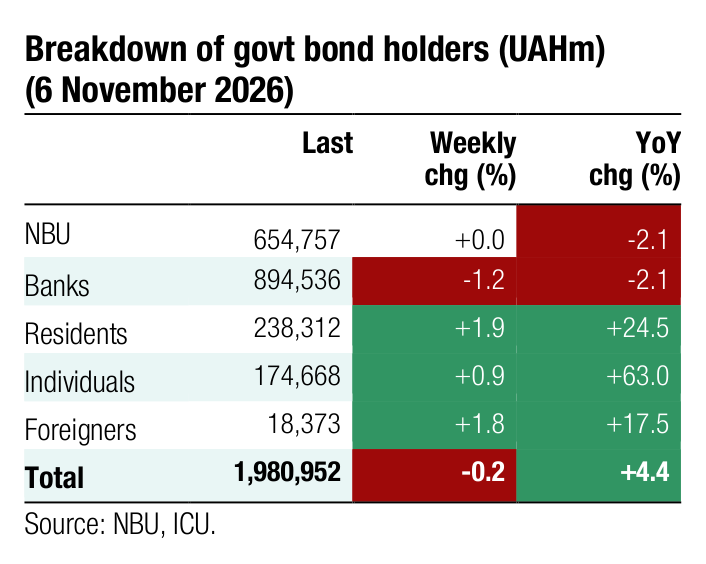
Population remains the most active bond investor YTD
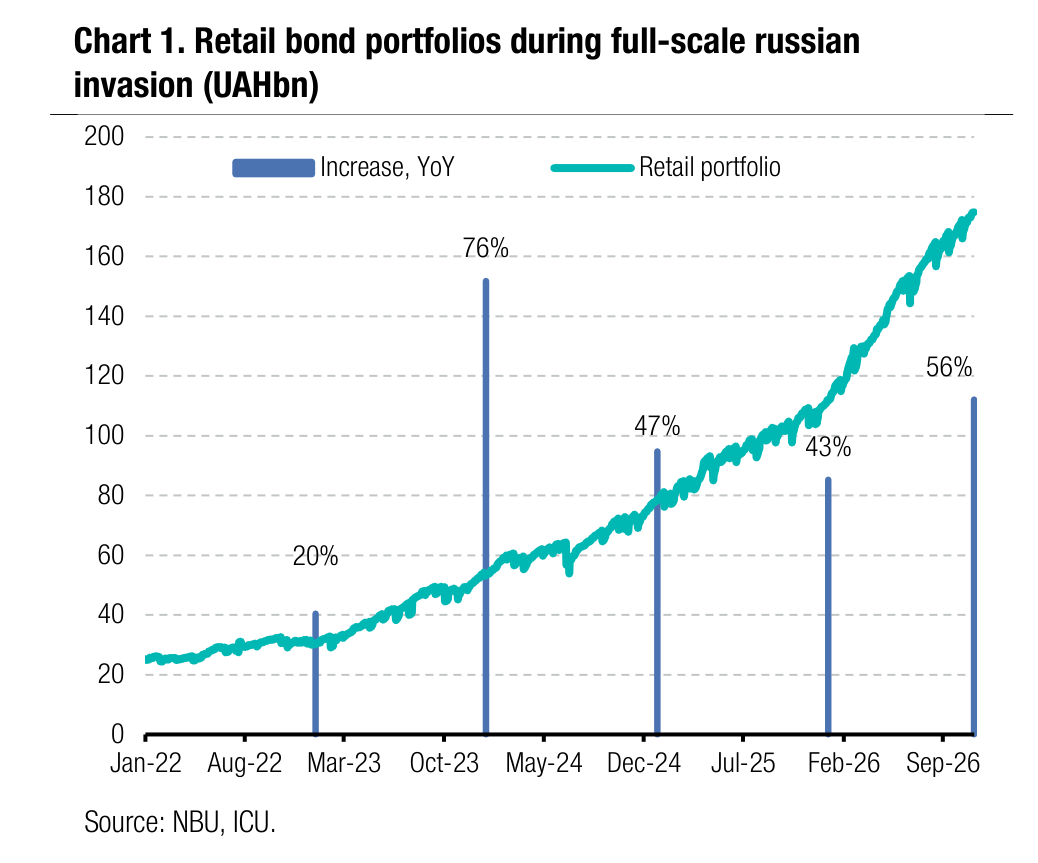
The combined portfolios of retail investors continue to grow fast, having increased 7x since the start of russian full-scale invasion. This year, households became the largest domestic lender to the state budget.
In October, portfolios held by individuals grew by over 3%, and YTD growth reached 56%. This pace exceeds that of the previous two years, despite a significantly higher comparison base. The share of UAH bonds in retail portfolios remains stable at around 61%.
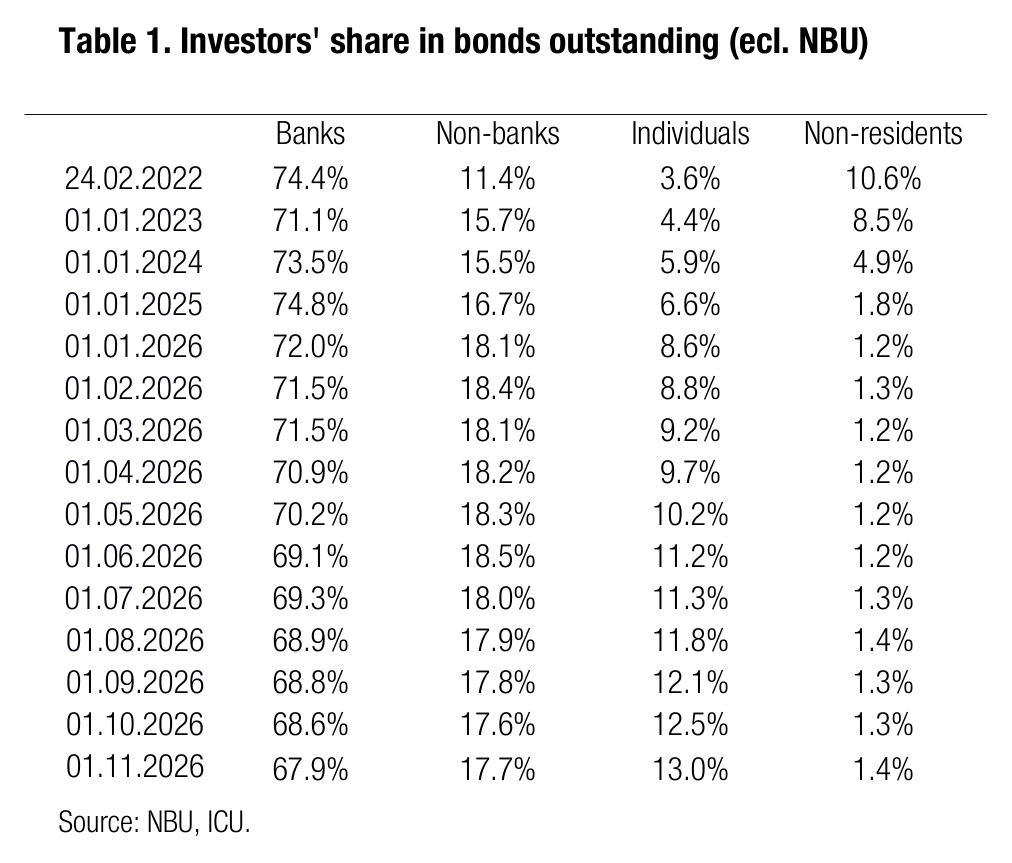
The total size of the retail portfolio is almost UAH175bn (US$3.8bn), up UAH61bn (US$1.3bn) over 10M26. The increase offset the reduction in portfolios held by banks by nearly UAH34bn (US$0.8bn). The share of the retail portfolio in total government bonds outstanding (excluding those held by the NBU) was up by 4.4p.p. YTD to 13%. Meanwhile, the share held by banks decreased by 4.1p.p. to 67.9%.
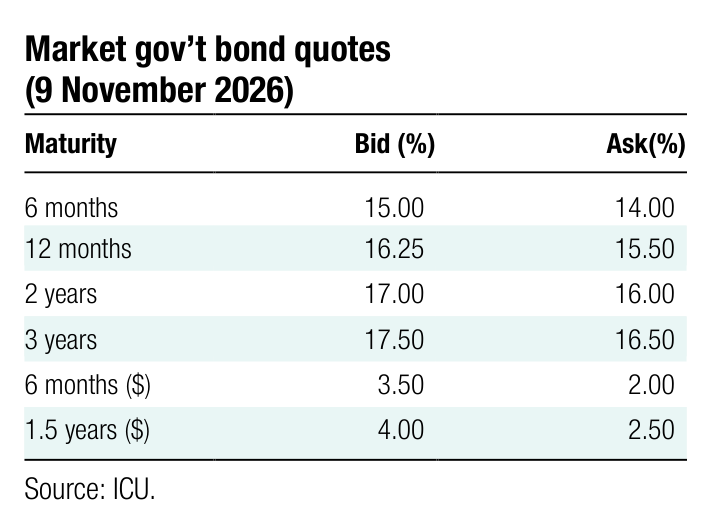
ICU view: Yields on UAH bonds remain significantly more attractive than interest rates banks offer on retail term deposits for individuals—especially considering that earnings on bonds are tax-exempt. The current yields on UAH bonds offer decent remuneration for retail investors that compensates for both inflation and FX risks. This is one of the reasons the Ministry of Finance refuses to raise bond yields at primary auctions further, largely ignoring the NBU rate hikes for a combined 150bp since July to 16.5%. Nearly all newly issued government bonds now end up in retail portfolios. We expect the household's role as a government creditor will continue to grow, provided the NBU prevents sharp fluctuations in hryvnia exchange rate.
Foreign exchange market
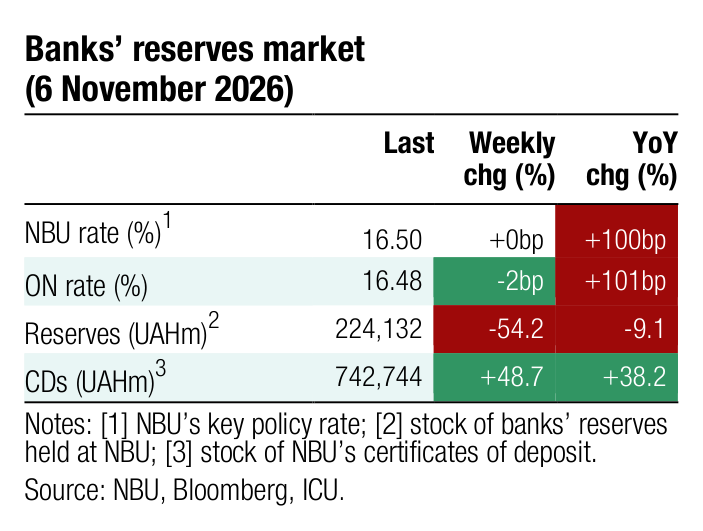
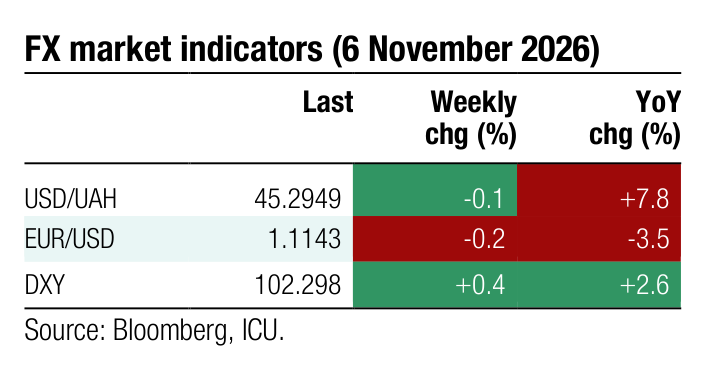
The NBU eases FX depreciation concerns
The NBU interventions remained largely unchanged compared with the last week of October—close to an all-time high—and helped to gradually lower the USD/UAH exchange rate by the end of the week.
The overall foreign-currency deficit widened further last week, reaching US$1.4bn. This was driven by 45% surge in the net demand of retail segment to over US$500m alongside a slight (below 3%) decline in net purchases by bank clients (corporate entities) to US$915m. To meet this heightened demand, the NBU sold almost US$1.8bn of foreign currency over the week, marginally less than in the last week of October.
Last week started with the hryvnia weakening from UAH45.35/US$ to UAH45.7/US$, and, thanks to the huge interventions, it moved back to UAH45.3/US$ by Friday.
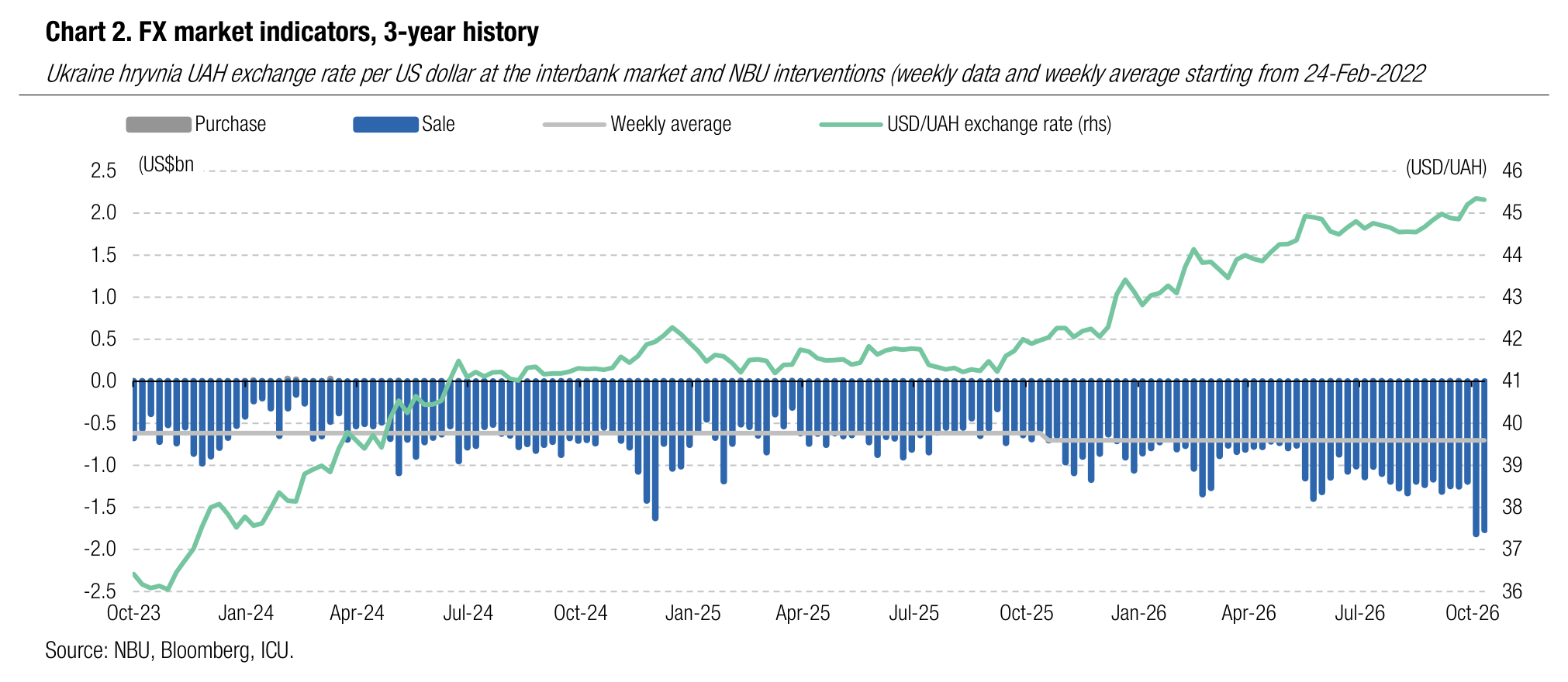
ICU view: The structural FX market shortage remains elevated, forcing the NBU to maintain very high intervention levels. This shortage stems from significant budget expenditures on weaponry—funded through the USL program—and a decline in export earnings due to logistical bottlenecks. A notable reduction in the inflow of funds from the treasury account into the banking system also helped the NBU ease pressure on the FX market. Meanwhile, the foreign currency deficit widened considerably in the retail segment amid significant exchange-rate volatility, as both buyers and sellers sought to hedge their FX risks. The upsurge in FX demand was further fuelled by the reset of monthly online FX purchase limits for individuals. As a result, that pushed FX purchases by households to new historic highs.
Economics
NBU reserves up 4% in October
Gross international reserves of the NBU increased 4.2% in October to US$49.1bn. Reserves were equivalent to 4.2 months of projected future imports, according to NBU estimates.
October unlocked significant new financial aid inflows from the EU that included a EUR2.9bn tranche of the Ukraine Facility and a US$4.6bn tranche of the defense component of the Ukraine Support Loan (USL). The government converted this USL tranche into hryvnia, so the NBU could include this money into gross reserves. On top, around US$0.4bn inflow was registered from the WB and US$0.2bn was the net positive effect of reserves revaluation. Meanwhile, the FX interventions reached an all-time high of US$6.1bn, thus offsetting a chunk of new foreign aid inflows.
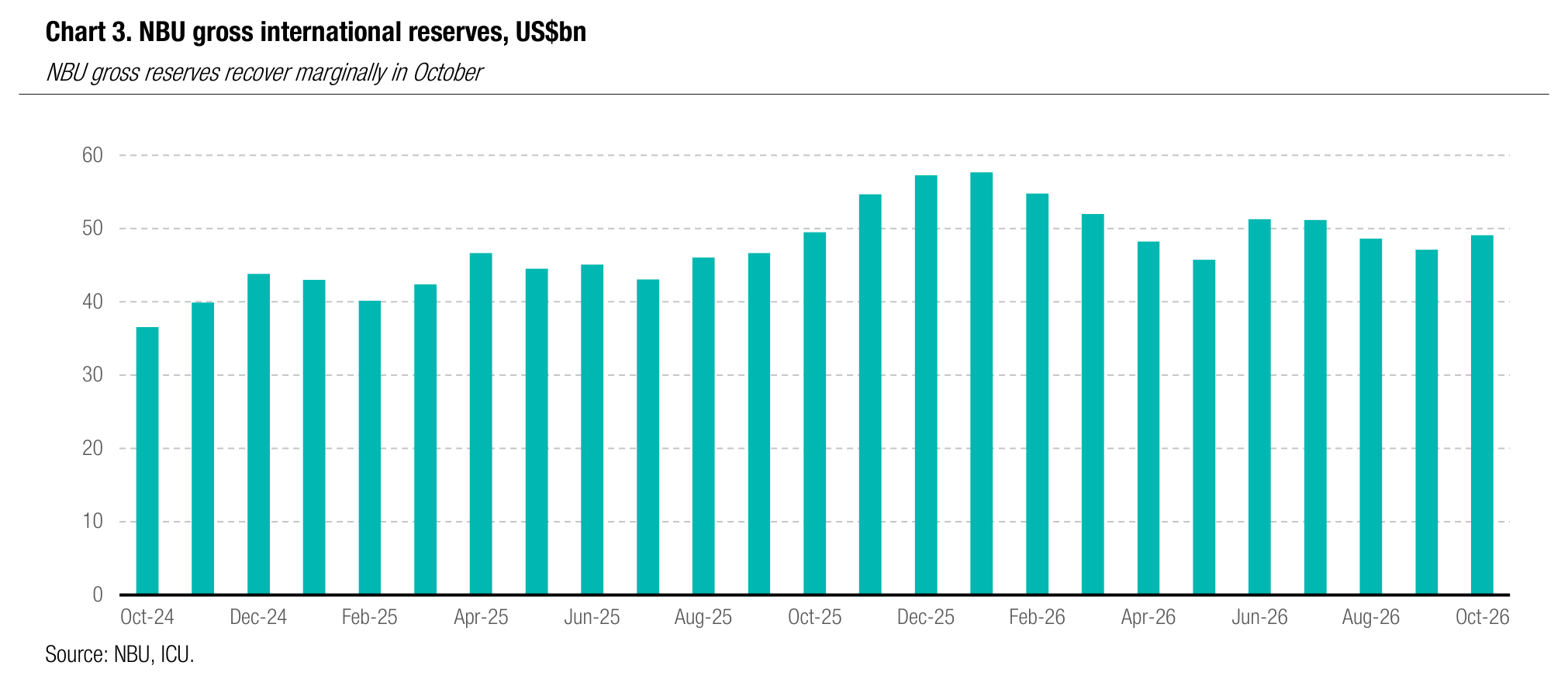
ICU view: We expect the government and parliament to continue fast tracking some of the critical economic and institutional reforms, so that the EU will be ready to disburse the financial aid scheduled for 2026 in full. This may bring NBU reserves back close to US$60bn at year-end, thus enabling the central bank to keep the FX market and hryvnia exchange rate under its full control.
Economy contracts in 3Q26
Ukraine’s real GDP was down 0.7% YoY in 3Q26 according to UkrStat preliminary estimates, as russia attacks on civil infrastructure and production facilities are taking their toll.
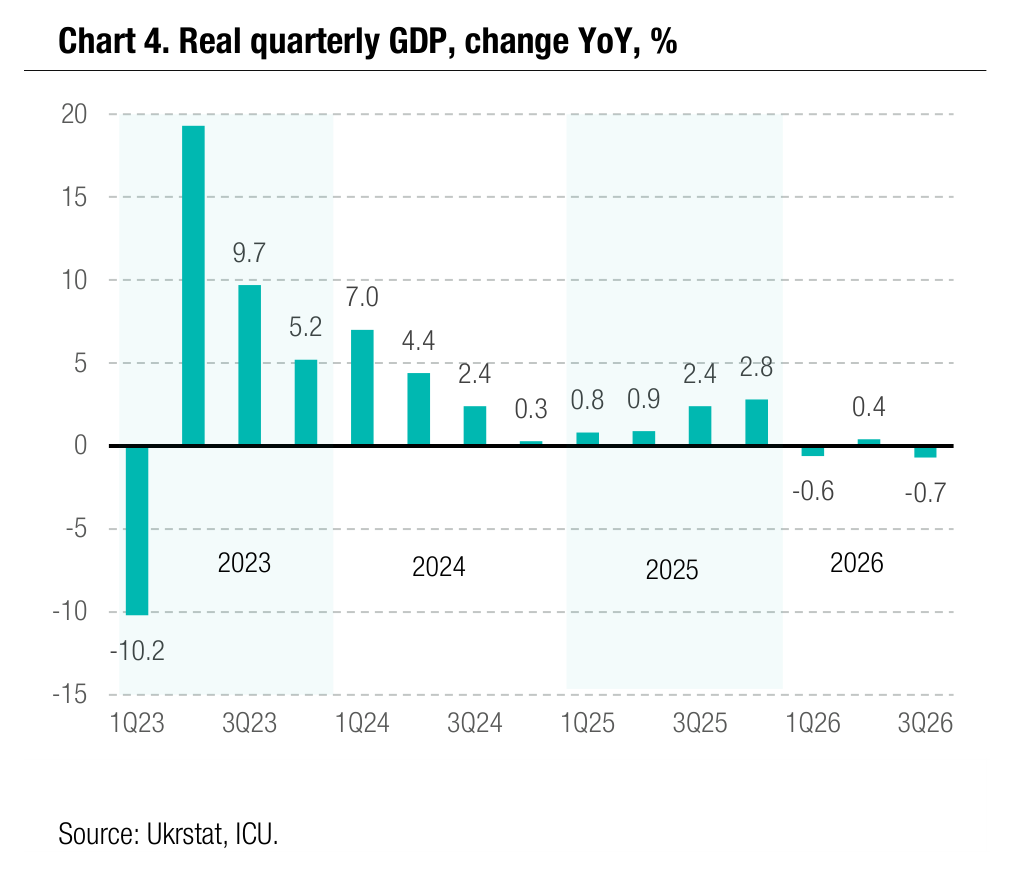
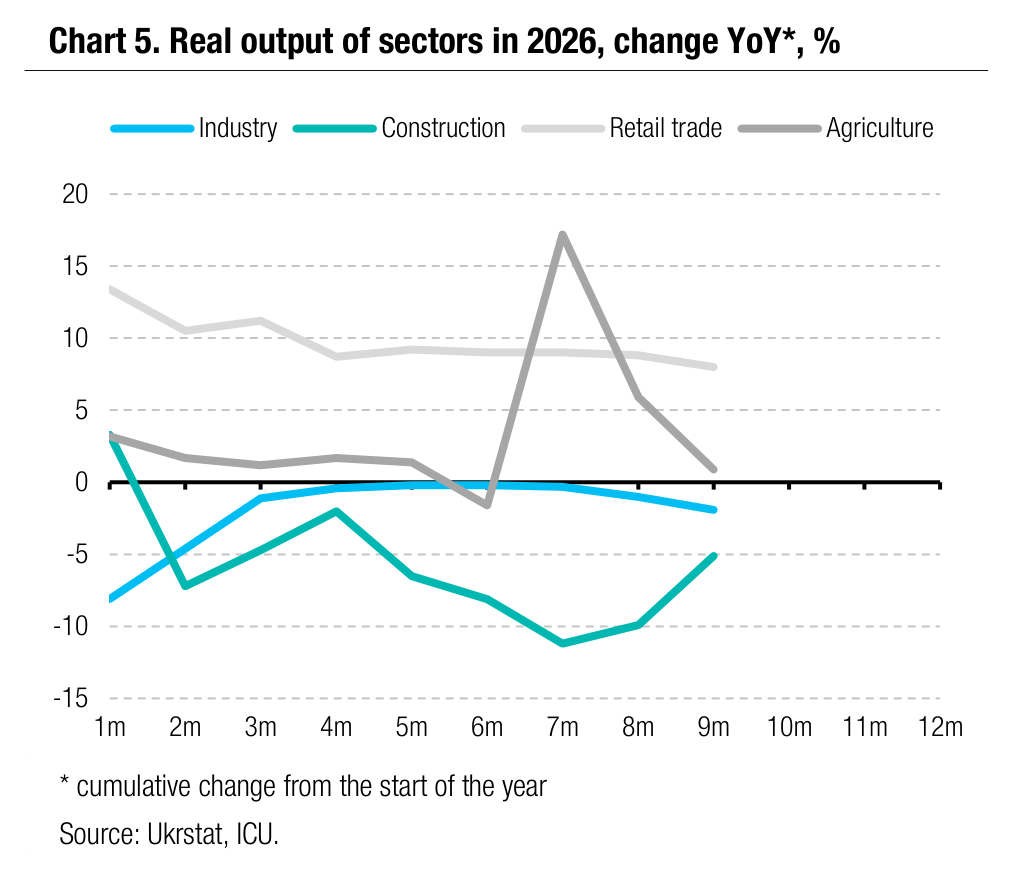
ICU view: As we commented in our latest Macro Insight , since mid-summer, businesses have faced the gravest challenges last seen in 2022 in the immediate aftermath of the full-scale russian invasion. Massive damage to warehouses, industrial production facilities, and transport infrastructure are causing economy contraction. The key economic sectors mostly hurt in 3Q are manufacturing, mining, and construction. Agriculture is holding up well on this year’s good harvest of grains and oilseeds, but facing growing challenges as farmers are struggling to sell their produce at above-cost prices. Retail trade is also starting to show signs of weakness as its real growth fell to just 2.7% YoY in September (though it was still high at 8.0% in 9M26). Slowdown in retail trade is a clear indication the private household demand is losing steam due to growing economic uncertainty and the population declining propensity to consume. With all these factors in mind, we earlier downgraded our economic growth forecast and now expect GDP contraction of 0.5-0.7% in 2026 and 1-2% in 2027.