

Ukrainian bond market
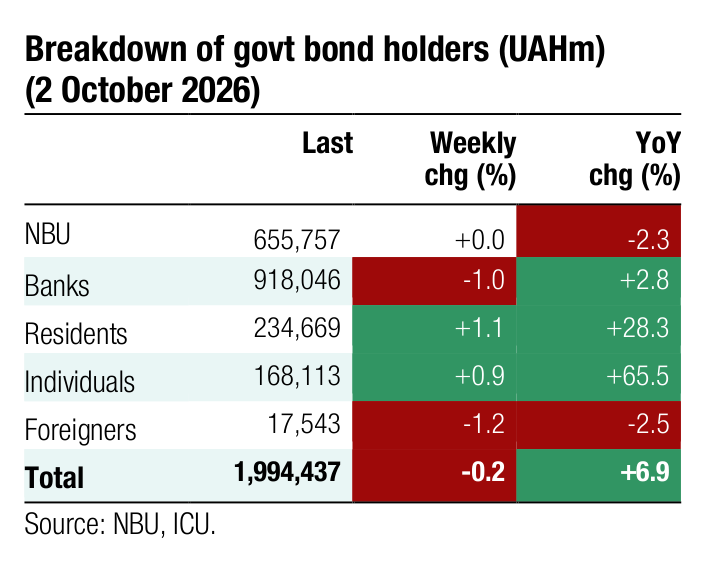
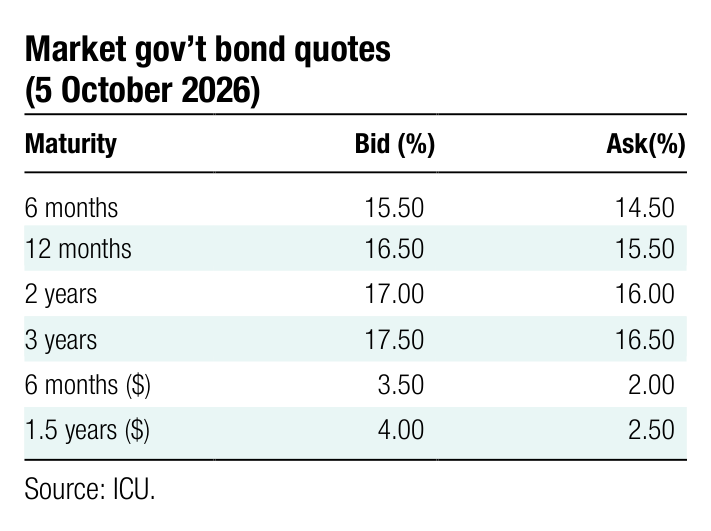
MoF continues to push rollover lower
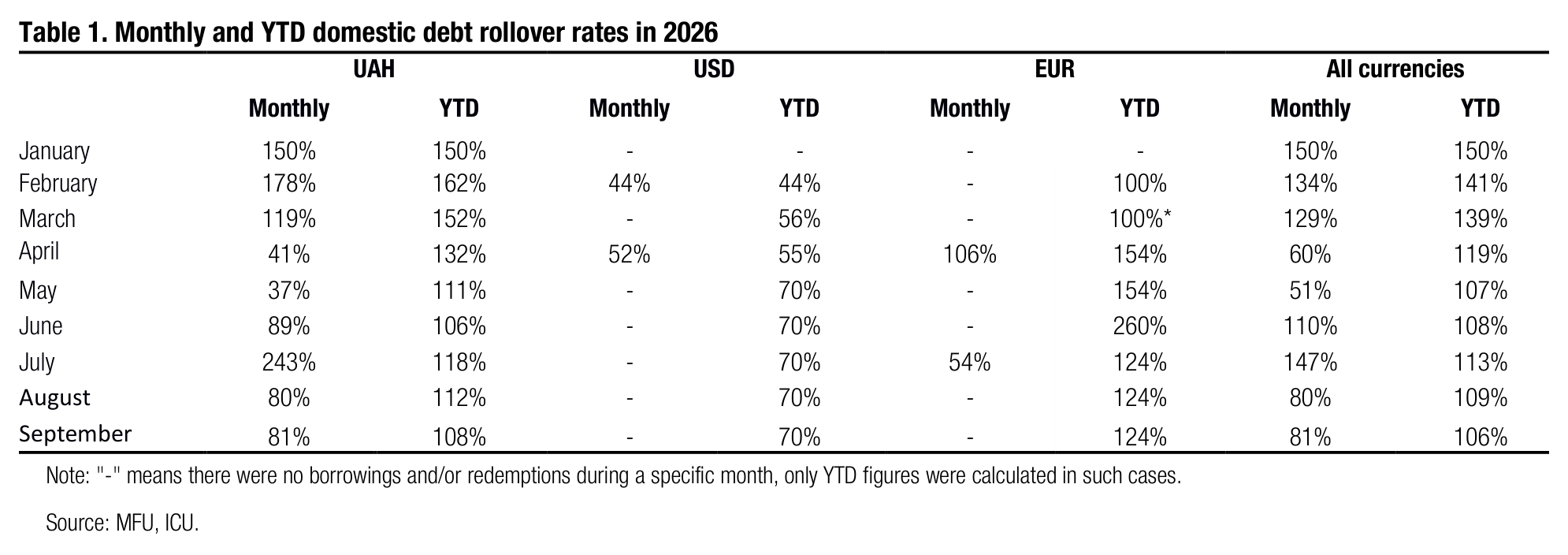
Borrowings in September were again below redemptions. Thus, the overall rollover ratio for 9M26 decreased by another 3pp compared with 8M26.
In September, the Ministry of Finance once again issued and redeemed only UAH- denominated bonds, leaving the rollover in US dollars and euros unchanged vs 7M26 at 70% and 124%.
Last month, the ministry issued UAH21.5bn of reserve bonds (including UAH11.5bn via an exchange auction for reserve securities maturing in October) and redeemed UAH16.8bn of reserve bonds (including UAH10.9bn via the exchange). The MoF also issued UAH6bn of military bills and UAH2.6bn of regular securities, while redeeming UAH20.5bn of military bonds. In total, borrowings in September amounted to UAH30bn vs redemptions of UAH37.3bn.
Thus, the rollover rate for UAH debt in September was 81%. This implies the 9M26 rollover was down to 108% (vs 112% for 8M26), and the overall domestic debt rollover across all currencies decreased to 106% for 9M26 (vs 109% for 8M26). For 4Q26, the MoF needs to repay over UAH88bn in bond principal, whereas the budget plan leaves only UAH58bn to be borrowed in the domestic bond market. However, if necessary, the ministry could refinance the entire repayment amount.
ICU view: The Ministry of Finance continued to insist on keeping UAH bond yields unchanged and rejected all bids that would have required higher cut-off rates. Consequently, borrowing volumes in September declined compared with August, even though the ministry held one extra auction. The pace of borrowings aligns well with the current budget plan, which envisages net debt repayments (rollover rate of less than 100%) for the full year. Therefore, we do not anticipate any immediate changes to the Ministry of Finance's yield policy, particularly if the domestic borrowing plan for 2026 remains unchanged. However, should budget constraints get tougher, the government may reconsider the plan to the domestic borrowings in 4Q26.
Foreign exchange market
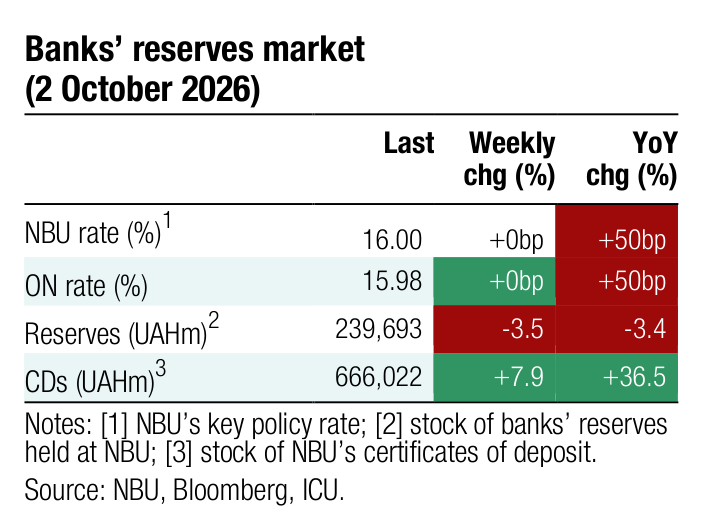
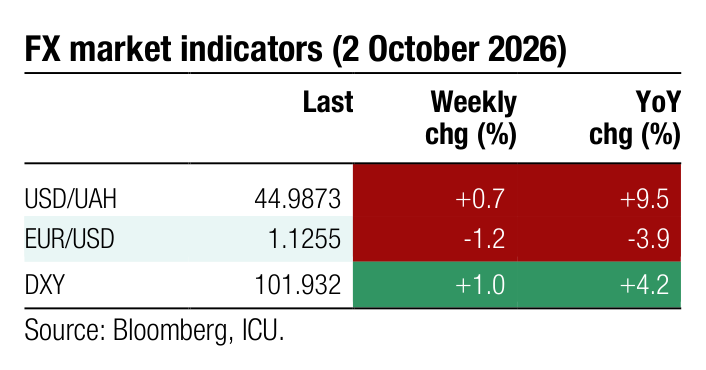
September interventions at all-time high
In September, NBU interventions continued to rise, reaching a new all-time high. This was driven by growing demand for foreign currency from both corporations and individuals.
September interventions of US$5.5bn were the highest on record and exceeded previous highs of December 2024 (US$5.3bn) and June 2026 (US$5.1bn). This upsurge was driven by a rise in FX purchases by both legal entities and households to US$4.9bn—also a record high. In September, net hard currency purchases by corporate clients totalled nearly US$4bn, while net purchases in the retail segment were US$921m, US$100m below the March peak.
Despite surging interventions, the NBU continued to keep the USD/UAH official exchange rate below UAH45/US$. The official exchange rate fluctuated between UAH44.30/US$ and UAH44.97/US$ in September. By the end of the month, the hryvnia had weakened by only 0.4% to UAH44.68/US$, bringing the YTD weakening to 5.5%.
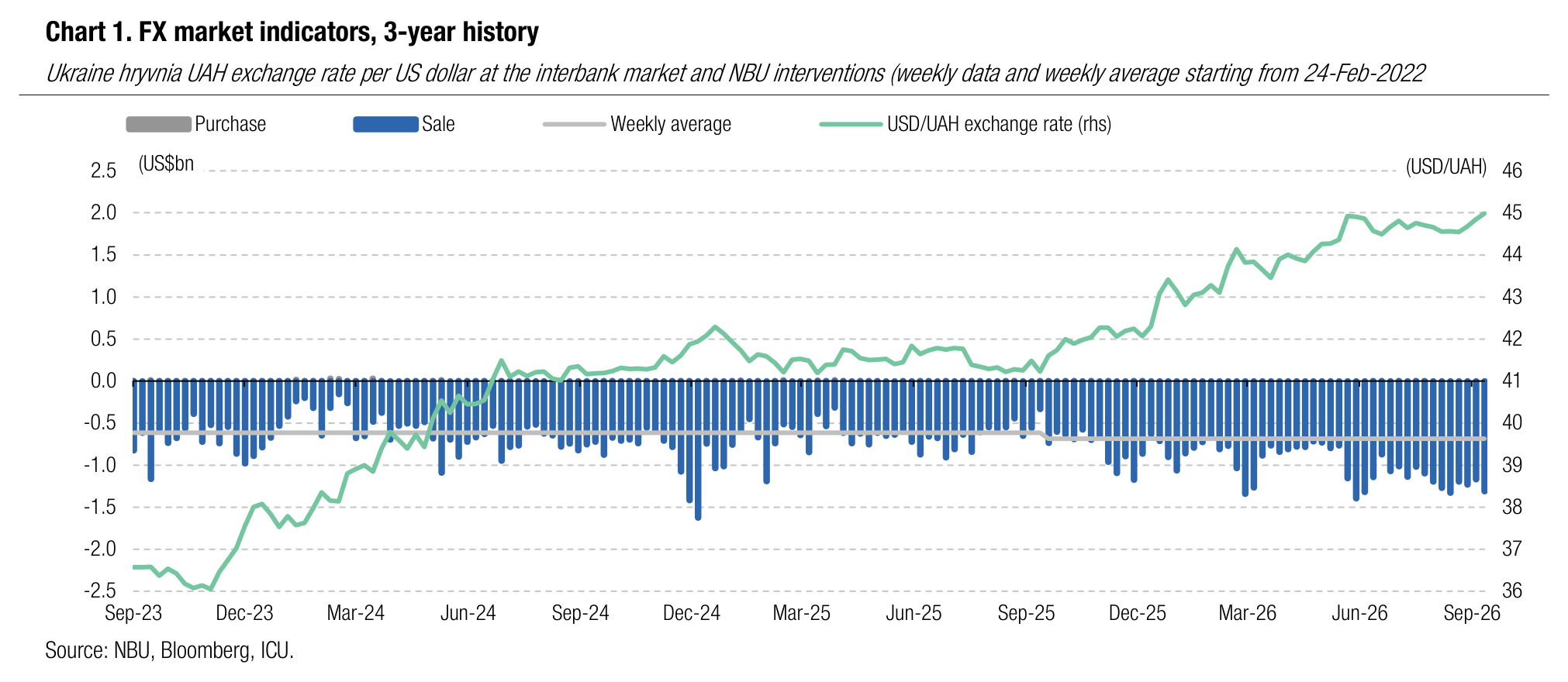
ICU view: In September, the National Bank proved it is determined to keep the hryvnia exchange rate flexible, but the range of fluctuations was effectively contained to 1%, which is still material by the recent standards. A weekly foreign currency deficit exceeding US$1bn has become the new normal, driven by a decline in agricultural exports and rising imports of components for domestic weapons’ production. The NBU had to step up market interventions this summer after the first tranches of the USL program arrived—specifically to manage the reallocation of hard currency to weapons’ producers. Consequently, the increase in weapons purchases will necessitate further increases in NBU interventions. At the same time, we anticipate that in 4Q26, the NBU will avoid a sharp hryvnia devaluation, but will gradually steer the exchange rate toward UAH45.8/US$.
Economics
C/A deficit surges on lack of grants
Ukraine’s current account deficit surged to $4.8bn in August as the ample trade deficit was not offset with budgetary grants. The 12-month C/A deficit stood at $23.5bn, close to 10% of 2026 GDP.
The deficit of trade of goods remained the key drag on the current account as export of goods tanked 19% YoY in Aug (+1% in 8M26) due to logistical bottlenecks following russia’s terrorist attacks. Import of goods continued to grow rapidly driven by energy materials and components for weapons’ production. Yet, unlike in June and July, the inflow of budgetary grants (primarily via the USL facility from the EU) was far from sufficient to offset the gap of external trade.
The financial account improved strongly in August at $1.7bn and that came on the back of a military component of USL that was transferred to Ukraine by the EU, but did not directly flow to the NBU reserves as this money has restricted use.
The combined balance of the current account and financial account was negative in August at $3.1bn, implying the NBU had to burn reserves to close the gap. The central bank gross reserves were down 5% MoM to $48.7bn.
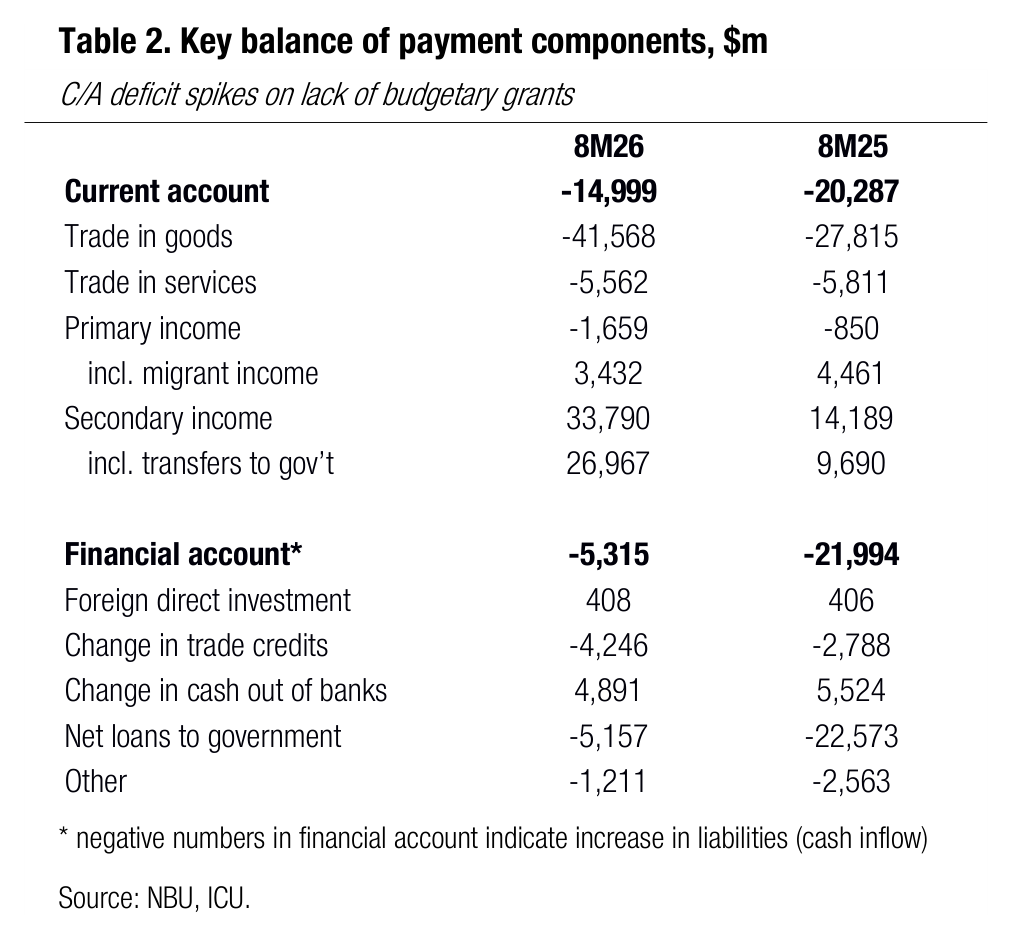
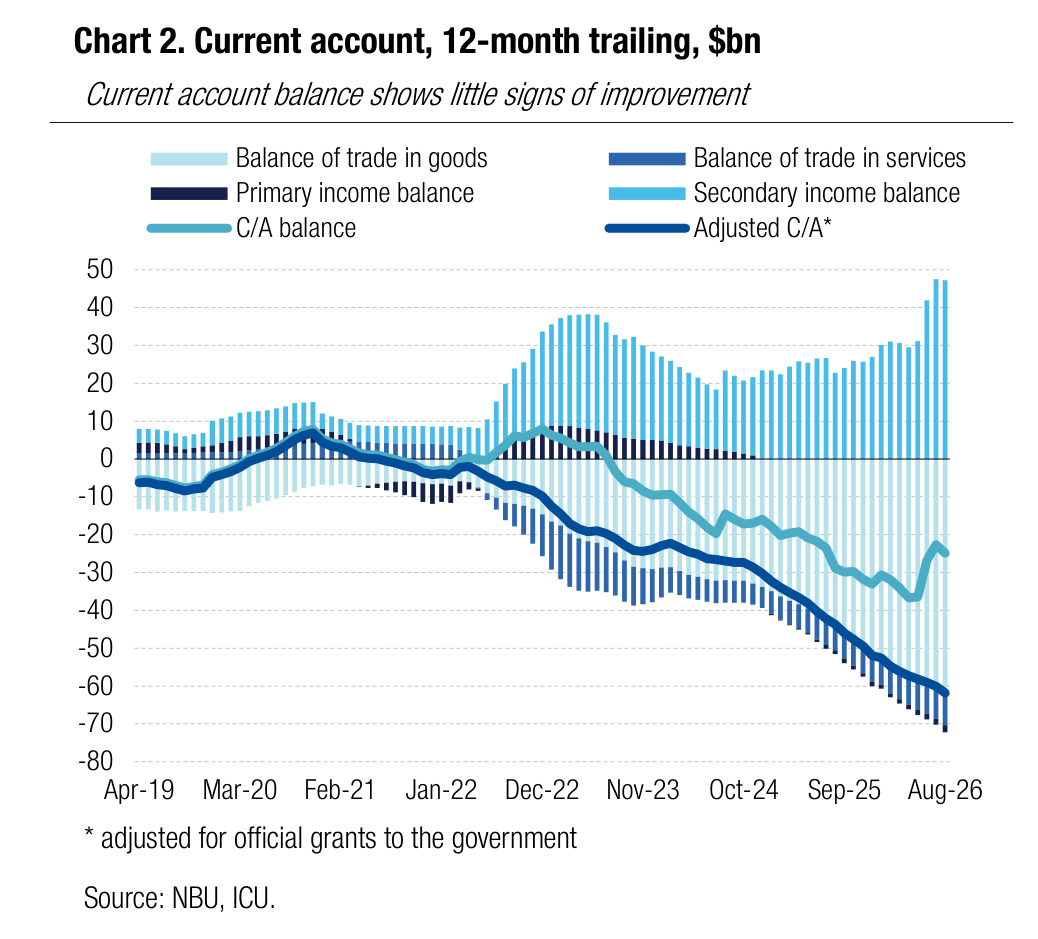
ICU view: Recent BoP data confirm the Ukrainian economy remains critically dependent on the foreign financial aid. The shortfall of external accounts (net of foreign aid) keeps widening, posing significant risks to macroeconomic stability. We remain of the view that foreign financial aid will remain sufficient to cover the external gap at least until end-1H27, but Ukraine badly needs to secure additional sources of funding to keep the risks under control during the war time.